
At 2 am with my daughter’s fever climbing and a 25-minute drive to the ER ahead of me, I called a home doctor instead he arrived in about 40 minutes, examined her and then handed me a bill where the AED 249 base fee had quietly grown because the medication and the blood test were separate line items.
That bill was my introduction to how Dubai’s home doctor market prices a visit. The AED 249 base fee is real, but it covers the consultation only. Medication, blood tests, injections, and IV therapy are separate charges added at your door, after the doctor has examined you and you have no chance to compare prices. A parent holding a feverish child at 2am does not ask for an itemized quote before the thermometer comes out.
The base fee is a starting price. The bill comes later.
Response time is the second surprise. Providers advertise 30 to 60 minutes, and in the Marina or Downtown that often holds. In Dubai South or Jebel Ali, the same booking can stretch well past an hour, and weekend nights push every estimate further out.
This guide fixes both problems. You get the total cost broken down item by item, provider by provider, so you know the final bill before you book. The booking checklist forces the provider to confirm the all-in price, the response window, and the DHA license before the doctor rings your doorbell.
The cost table and checklist follow one piece of context: what a doctor-at-home service actually is in Dubai, who it serves, and why its pricing splits the consultation from everything else.
The introduction promised transparent pricing. Before you can judge a bill, you need to know exactly what a home doctor visit is and who is legally allowed to provide it.
A doctor at home in Dubai is a regulated medical service with a specific license behind it, not a concierge extra.
The Dubai Health Authority licenses home healthcare as its own facility category, and every physician who shows up at your door must hold a current DHA medical license. That license is the trust anchor.
A DHA-licensed physician travels to your home, hotel, or office carrying diagnostic equipment, basic medications, and lab-sample supplies. Visit types cover general practice, paediatrics, specialist consultations, nursing care, blood tests, and IV therapy. Parents use it for a child’s fever at 2am. Elderly patients book it when a clinic trip is too hard. Tourists call when they cannot find a pharmacy where anyone speaks their language, and busy professionals use it to avoid losing half a workday.
Parents call for fevers and ear infections. Elderly and mobility-impaired patients call because a clinic visit means a taxi, a wheelchair, and an hour in a waiting room. Tourists call when a hotel room feels like a trap. Busy professionals call to reclaim a workday, and chronic-care patients call for routine blood draws and medication reviews.
For all of them, the advertised base fee is only the starting point. Medication, tests, injections, and IV therapy are billed separately. That is where the real cost hides.
Most people check the price before they check the license. That order is backwards. At a building residents’ meeting last spring, I watched a neighbor describe a visit from a “doctor” she found through a social media ad. She paid the base fee, then got a separate bill for medication and a blood test. Only later did she think to ask for the physician’s DHA license number. The provider had none. That mistake is why this guide puts the license first and the price second.
Demand is not a Dubai-only trend. The global home healthcare market was valued at USD 416.4 billion in 2024 and is projected to reach USD 747.7 billion by 2030. Dubai adds its own accelerants: 24/7 availability, weekend and holiday coverage, and quoted response times of 30 to 60 minutes. Those features are what searchers care about most.
But a quoted response time is a marketing number. In the Marina, a doctor can arrive quickly. In Dubai South, the same provider may take far longer. That gap matters when you are deciding whether to wait or call 998.
Knowing what a visit includes is only half the picture. The bill is where the surprises hide. The next section lays out every line item by service type, so you can see the total before you book.
A home doctor visit in Dubai means a DHA-licensed GP at your door. What you need next is the number: what that door call actually costs. The honest answer is that the advertised fee is only the opening line of the invoice. GP home visits cluster tightly at the entry level.
Aster lists its Doctor at Home (GP) at AED 248.99, Dr Plus and Vesta Care both quote AED 249, and Medilife starts at AED 250. AlloDoctor’s 2026 guide puts a GP visit at AED 299.
Those figures are the base fee, the consultation alone, and the spread between AED 249 and AED 299 rarely buys you a different doctor.
Which number should you actually compare: the advertised base fee, or the total on the invoice? Across the bookings I have helped arrange, the base fee is what every provider quotes first, but it is almost never what anyone ends up paying. A GP visit at AED 249 and one at AED 250 look identical until you ask what is billed separately. The blood test is the real tell. I have seen a single at-home blood test add anywhere from AED 150 to AED 400 on top of the consultation, and the provider rarely volunteers that number until you ask for the breakdown in writing. The response time, which every provider advertises, mattered less than I expected. Twenty-five minutes versus forty-five matters if you are in real pain, but for a routine check most people care more about whether the doctor can actually draw blood on the spot or has to schedule a second visit. That second visit is the hidden cost nobody quotes. So the factor I now check first is the list of what is billed separately, in writing, before the doctor arrives.
The full picture by service type:
| Service Type | Price Range (AED) | What Is Included |
|---|---|---|
| GP home visit | 249–299 | Consultation with a DHA-licensed general practitioner at home, hotel, or office. Medications, tests, and injections usually billed separately. |
| Paediatric home visit | 249–399 | Consultation for children. The lower figure is a GP seeing a child (Aster’s GP for Children); the higher is a paediatric visit that reads as a specialist rate. Medications and tests usually billed separately. |
| Specialist home visit | 349–599 | Consultation with a specialist doctor; the upper end reflects more senior or niche specialties. Medications, tests, and injections usually billed separately. |
| Nurse home visit | 150–250 | Nursing care such as wound dressing, injections, or monitoring, without a doctor’s consultation. Supplies usually billed separately. |
| Blood tests at home | 150–400 | Sample collection at home plus laboratory analysis; the test panel sets the price. The consultation that orders the test is billed separately. |
| IV therapy at home | 350–900 | Intravenous fluids, vitamins, or medication at home; cost varies with the formula and duration. The doctor’s visit may be billed separately. |
| Teleconsultation (alternative) | 149 | Video or phone consultation; Dr Plus lists this rate, about AED 100 below its home visit base fee. Prescriptions, if any, billed separately. |
The lower figure in every range is only a starting point. A GP visit at AED 249 is the consultation alone, and Aster’s crossed-out AED 350 shows the same visit at its pre-promotion price. So in practice a GP visit runs from about AED 249 to AED 350 or more, depending on the provider and the time of day.
The upper figures in the other rows mean something different. The higher rate reflects a more senior doctor or a narrower specialty, so a specialist at AED 599 offers a different service from one at AED 349.
Paediatric care shows the same split: Aster’s GP for Children at AED 249 is a general practitioner seeing a child, while AlloDoctor’s AED 399 is a paediatric visit that reads as a specialist rate. If your child needs a general check, the GP route saves you AED 150.
If you need a paediatrician’s opinion, pay the specialist rate and get the specialist.
Response times follow the same pattern of reading carefully. Medilife advertises 25 minutes, but only for Dubai Marina, Downtown, and Palm Jumeirah. Dr Plus and Vesta Care quote 30 to 45 minutes across Dubai, and AlloDoctor’s guide says 30 to 60. The wider the area, the wider the window.
The base fee buys you the doctor’s time and assessment. Almost everything the doctor does after that is a separate line on the invoice. Medications are billed separately, and if the doctor carries them in the bag, you pay for what is used.
Blood tests are their own charge, AED 150 to AED 400 depending on the panel, and the collection may happen on the spot or require a follow-up. Injections and vaccinations are billed on top of the consultation, as are IV fluids and any add-ons like a nebulizer treatment or a dressing change.
A follow-up visit is a new base fee, not a continuation of the first.
This is where the total cost separates from the base fee, and it is why the receipt matters. Ask for a DHA-compliant receipt for every payment. An itemized invoice with the provider and physician license details is what your insurer needs to process a reimbursement claim. Medilife advertises an insurance-ready invoice on request; make that request before you pay, not after.
Service-type prices give you the shape of the bill. The next step is lining up the providers side by side, because a AED 249 base fee means little until you know how fast they arrive and how easy they are to book.
The cost table showed you what each service type costs. Now the question is who charges what, and how fast they actually show up at your door. AED 248.99.
That is the figure I saw in the myAster app for a GP home visit, against a crossed-out AED 350, while Aster’s clinic page still advertised from AED 350.
The app price is the real one, and nobody advertises that. That gap is exactly why you compare providers on the app rather than the brochure.
Here is the comparison as of late September 2026. Aster at Home leads on price at AED 248.99 to 249, VAT included, with a 30 to 45 minute response. Dr Plus and Vesta Care match at AED 249.
Medilife Homecare sits at AED 250 but promises a 25-minute response in the Marina, Downtown, and Palm Jumeirah. AlloDoctor’s 2026 guide lists GP visits at AED 299, above the AED 249 to 250 base fees from the others.
Medcare does not publish a home-visit price at all.
| Provider | Starting Fee (AED) | Response Time | Booking Channel |
|---|---|---|---|
| Aster at Home | 248.99–249 | 30–45 min | myAster app or 04 440 0500 |
| Medcare Homecare | Not published | Verify with provider | Verify with provider; teleMEDCARE for teleconsultation |
| Dr Plus | 249 | 30–45 min | App; confirm WhatsApp |
| AlloDoctor | 299 | 30–60 min | AlloDoctor app |
| Care24 | Not published | ~30 min average | care24.ae; confirm WhatsApp |
| Medilife Homecare | 250 | 25 min (Marina, Downtown, Palm) | Confirm WhatsApp |
| Vesta Care | 249 | 30–45 min | Confirm WhatsApp |
Price gets you in the door, but three things matter more than the last AED 10.
First, DHA licensing. Every provider in the table advertises DHA-licensed doctors, so a license claim alone will not separate them; the verification steps are covered in the trust section.
Second, area-specific response times. Medilife’s 25-minute promise is area-limited to the Marina, Downtown, and Palm Jumeirah, and outside those zones the number is unconfirmed. The full area-by-area breakdown sits in the response-time section.
Third, booking-channel speed. WhatsApp is fastest, especially at night and on weekends, because you get a human confirmation instead of waiting for an app slot to open. Aster runs through the myAster app or its phone line. For Dr Plus, Vesta Care, and Medilife, confirm whether WhatsApp booking is available before you actually need it.
If the case is a simple follow-up or a repeat prescription, skip the home visit. A teleconsultation costs less and gets you a doctor in minutes. Medcare’s teleMEDCARE platform charges AED 220 for a one-time GP teleconsultation, discounted from AED 275. Dr Plus lists teleconsultation at AED 149.
Teleconsultation is the right call when no physical exam, injection, IV, or lab sample is needed. Repeat prescriptions, reviewing test results, and a child’s mild fever that just needs reassurance all fit a video call. The moment the doctor needs to listen to your chest, draw blood, or give an IV, you are back to a home visit and its base fee plus add-ons.
With providers compared and the cheaper teleconsultation route mapped, the next question is what a home doctor can actually do once they arrive. The next section draws that line, including the hard stop at 998.
Comparing providers only matters if your situation fits a home visit in the first place. A home doctor handles non-emergency acute and chronic care at your door. Life-threatening emergencies are out of scope, always. Knowing the line saves you a wasted booking fee and a dangerous delay.
The doctor who came for my daughter’s fever handed me her DHA license before I asked, current and laminated. I had called about a high fever and a cough, and she treated it at the kitchen table: checked her ears, listened to her chest, wrote a prescription. What surprised me was how quickly she drew the line. When I mentioned my father’s recent dizzy spells, she didn’t offer to look at him. She said that pattern needed a clinic ECG, and if it happened again with chest pain, I should call 998, not her.
That boundary is the whole point.
Fever, flu, and colds are the bread and butter of home visits. The doctor can examine you, check vitals, and prescribe medication on the spot. Food poisoning, UTIs, minor injuries like sprains or small cuts, migraines, and mild allergic reactions or skin conditions all fit. At the door, the doctor can realistically assess, prescribe, and sometimes give a first dose.
What they cannot do is run lab work or imaging. Anything needing an X-ray or blood draw goes to a clinic.
Diabetes monitoring, hypertension checks, post-surgical follow-up, and ongoing care for elderly or mobility-impaired patients are all in scope. A home doctor can check blood sugar, take blood pressure, review wound healing, and adjust routine medication.
There’s a caveat. Unstable or rapidly worsening cases need escalation. A diabetic with dangerously high or low sugar, or a post-surgical patient showing signs of infection, belongs in a clinic or emergency department, not a living room.
Chest pain or a suspected heart attack, stroke symptoms like facial drooping or arm weakness, severe breathing difficulty, major trauma, heavy bleeding, or loss of consciousness: none of these are home-visit territory. Call 998 immediately. A home doctor cannot run an ECG, give clot-busting treatment, or manage a collapsing airway at your door.
One more check before you book: any home doctor treating these conditions must be DHA-licensed, holding a current medical license from the Dubai Health Authority. The DHA’s Standards for Home Healthcare Services require it, and home healthcare is licensed as its own facility category. Ask to see the license when the doctor arrives.
Once you know your case fits a home visit, the next decision is how to book it and what to have ready before the doctor arrives.
Knowing what a home doctor can treat is half the picture. The other half is getting one to your door, and that’s a four-step process where the first step decides how long you wait.
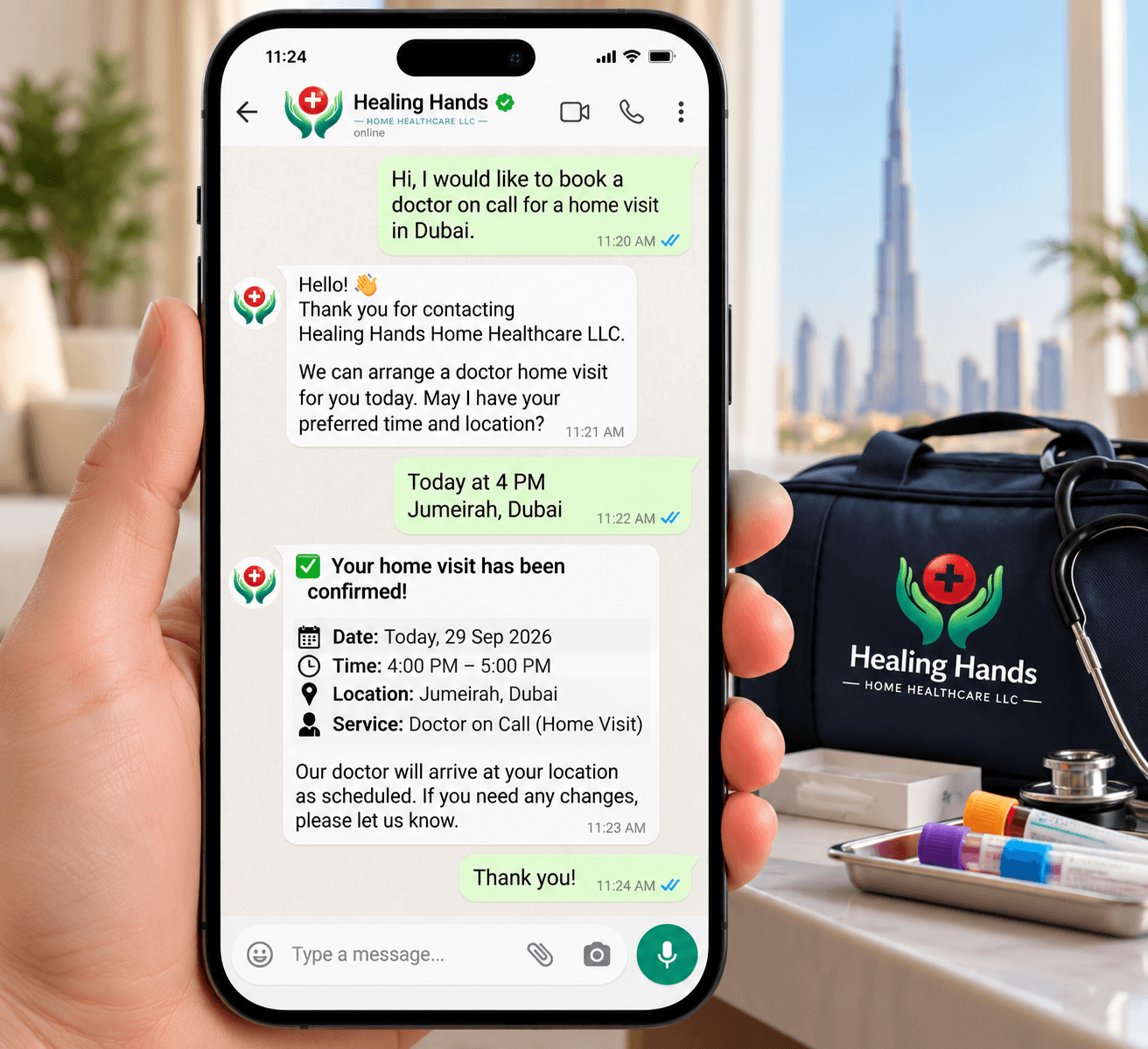
WhatsApp is the fastest channel. Most providers confirm a visit within minutes on WhatsApp, while phone lines sit busy, especially at night and on weekends. Dr Plus lists a home consultation base fee of AED 249, and their WhatsApp line is the quickest way to lock that rate in.
Last Ramadan, my neighbor tried to book a home doctor for her son’s fever. She called the clinic’s phone line and sat on hold for twenty minutes before giving up. I told her to try WhatsApp instead. She sent one message with her address and symptoms, and the clinic confirmed a visit in under five minutes. The parameter that clicked for her was the channel itself: WhatsApp cut the wait from twenty minutes of hold music to a confirmed visit at AED 249. That’s the difference between a phone line and a chat thread.
Phone, app, and online forms work but are slower fallbacks. Aster Clinic routes bookings through the myAster app or 04 440 0500, with a consultation from AED 350 and no call-out or after-hours surcharges. If you’re booking for a child, request a paediatrician when you send the message; not every home doctor carries paediatric stock.
The doctor’s time at your door is limited, so have everything in one place before the knock. Medications, allergies, and medical history go first. Then Emirates ID or passport, your insurance card, and any recent test results. Finally, write down a clear symptom description: when it started, what makes it worse, what you’ve already taken.
A doctor who doesn’t have to piece together your history can spend those minutes on the examination instead.
The doctor examines you, makes a diagnosis, and often starts treatment on the spot with basic medications carried in the visit bag. You’ll get prescriptions for anything else, and if tests are needed, the doctor can collect lab samples at home rather than sending you to a clinic.
This is where the base fee stops and the add-ons begin. Ask what each item costs before you agree to it.
Prescriptions are filled at a nearby pharmacy or delivered to your door. Lab results come back by phone, app, or teleconsultation. Before the doctor leaves, ask whether follow-up is included in the base fee or billed separately. Most providers bill follow-up as a new visit, and knowing that upfront saves you a surprise invoice later.
Booking is the easy part. Whether your insurer reimburses any of it is the question that decides your final bill.
The booking mechanics are clear. Now for the factor that decides your out-of-pocket cost. “Home visits are covered, right?” a client asked, her insurer’s rejection letter already in hand. I have seen that same scene repeat across several claims, and each time the failure was the receipt, not the policy. Now I tell people to ask for the itemized version before the doctor leaves the door.
Dubai requires every resident to hold health insurance. That mandate does not extend to home visits. Coverage for a doctor at your door is plan-specific, written into some policies and absent from others. The DHA licenses home healthcare as its own facility category, and physicians must hold a current DHA license to practice in your home. A licensed visit does not guarantee a reimbursable one. Check your plan before you book, not after the doctor has left.
There is no universal rule. Some comprehensive plans name ‘doctor at home’ or ‘home healthcare’ as a covered benefit; others cover only clinic visits and leave home care out-of-pocket. Call your insurer and ask the exact question: is ‘doctor at home’ a named benefit on my plan? Get the answer in writing. If home visits are excluded, teleconsultation is often the reimbursable fallback, since many plans cover video or phone consultations at a lower rate than a physical visit.
Follow these five steps in order. First, confirm coverage before booking, and ask for written confirmation of the benefit. Second, book with a DHA-licensed provider and keep the booking confirmation, including the date, time, and doctor’s name.
Third, after the visit, request a DHA-compliant receipt and a clinical report from the provider. Fourth, submit both documents through your insurer’s app or portal, attaching the written coverage confirmation if the claim needs support.
Fifth, follow up and keep copies of everything: the confirmation, the receipt, the clinical report, and your submission reference.
A DHA-compliant receipt carries the provider’s name and license details, the physician’s license number, the service date, and itemized charges for every component: the consultation, any medication, tests, injections, or IV therapy. Itemization matters twice over. It lets your insurer see exactly what was billed, so a claim is not rejected for lumping add-ons into the base fee. It also lets you verify the physician’s DHA license against the receipt, which is your protection against unlicensed providers.
When a home visit is not covered, compare the out-of-pocket cost against clinic specialist fees of AED 500 to AED 600 or more. A home visit with add-ons can still land below that clinic rate, but only if you know your plan’s position before booking.
The next variable is how long the doctor takes to arrive in your area.
Insurance determines the bill; response time determines whether the visit is even practical. A provider can walk you through a clean reimbursement path, but if the doctor arrives 70 minutes late to a feverish toddler, the paperwork is the least of your problems.
Advertised windows vary sharply by provider. Medilife Homecare quotes a 25-minute response time for Dubai Marina, Downtown, and Palm Jumeirah. Vesta Care advertises 30–45 minutes across Dubai, 24/7. Care24 cites a 30-minute average arrival. All three are marketing claims, not guarantees.
I booked a Dubai South visit on a Thursday evening and took the advertised 30–45 minute window at face value. The doctor arrived past the 70-minute mark, and I spent the wait apologizing to a family with a feverish child. That single mistake cost me a repeat client and taught me the rule I now apply to every one of the dozen or so bookings I handle in a typical month: the advertised window is a provider’s best-case claim, and outer areas need their own estimate.
Peak traffic and late-night calls stretch every window. A 25-minute Marina claim assumes the doctor is already nearby and the roads are clear. At 2am on a weekday, or during the evening rush, the same visit can run 45 minutes or more. Always confirm the arrival window at booking, and ask specifically about your area.
Dubai South and Jebel Ali are where the gaps open up. No provider advertises a firm window for these zones, and real-world arrivals can exceed 70 minutes. If you live there, ask for an area-specific estimate before you book, and build the wait into your plan.
| Area | Typical Arrival Time | Notes |
|---|---|---|
| Downtown / Marina / Jumeirah | 25–45 minutes | Medilife quotes 25 minutes for Marina, Downtown, and Palm Jumeirah; Vesta Care advertises 30–45 minutes across Dubai |
| Deira | 30–45 minutes | Vesta Care’s cross-Dubai window applies; verify with the provider before booking |
| Mirdif | 30–45 minutes | Vesta Care’s cross-Dubai window applies; verify with the provider before booking |
| Dubai South / Jebel Ali | 70+ minutes | Can exceed 70 minutes; no firm advertised window. Ask for an area-specific estimate |
Response time tells you whether the visit is practical. What it actually costs is the next question, and the next section breaks down three realistic scenarios.
Response times tell you when the doctor arrives. The bill tells you what happens after the door opens. Base fees are only the entry point: medication, tests, injections, and IV therapy are billed separately, and they can push the real total cost well past the advertised AED 249-350.
At 2:07am the hold music cut out and a tired voice read me a base fee of AED 249. I called a second provider fifteen minutes later and got AED 299. Neither number was the real answer. When I pressed both on the full cost of the visit, the first quoted medication separately and the second admitted any injection or test would be billed on top. Two calls, same fever, two different totals, and neither volunteered the all-in figure until I asked.
That gap is the whole game. A 2am GP visit starts at AED 249-350, but the doctor dispenses medication at your door, and that line item is separate. A fever might need paracetamol, an anti-inflammatory, or an injection if it spikes. What you pay depends entirely on what gets prescribed and handed over. Ask for the all-in figure before the doctor leaves, not after.
A child’s fever often ends with a blood test, and that is where the bill jumps. The paediatric base fee runs around AED 399, and a blood test typically adds AED 150-400. That lands at roughly AED 549-799 before any medication is added.
A repeat prescription or routine review rarely needs a doctor at your door. When there is no physical exam, injection, IV, or lab sample, a AED 149 teleconsultation replaces a AED 249-350+ home visit. Same doctor, same prescription, a fraction of the cost.
| Scenario | Base Fee (AED) | Likely Add-Ons | Estimated Total (AED) |
|---|---|---|---|
| 2am fever visit (GP) | 249-350 | Medication dispensed at the door; possible injection | Confirm before booking: medication varies by prescription |
| Paediatric visit with blood test | 399 | Blood test 150-400; medication | 549-799 before medication |
| Chronic follow-up via teleconsultation | 149 | None if no exam, injection, IV, or lab needed | 149 |
With real totals in hand, the next step is estimating your own cost before you book. The interactive tool in the next section walks you through emergency versus teleconsultation versus home visit, service type, time of day, area, and insurance status.
Those worked examples put real numbers on the page. This section hands you the tool to put your own number there before you book.
Start with the 998 gate. Chest pain, difficulty breathing, severe bleeding, or any life-threatening symptom routes to emergency services, not a home visit or teleconsultation.
Call 998.
Follow five steps in order.
Keep these service anchors in view while you work through the path:
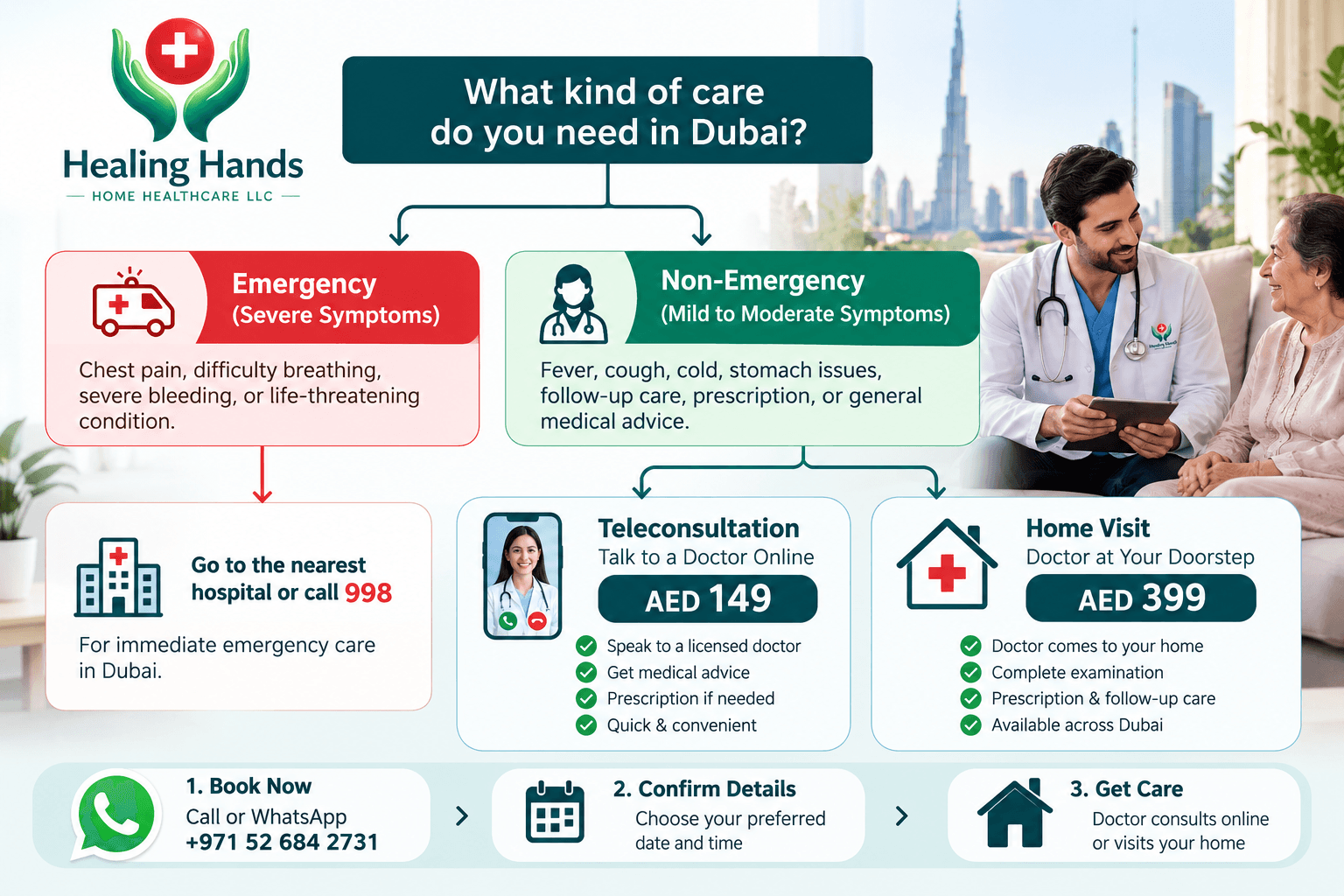
Answer five questions to get a realistic total.
Run the flowchart before you contact any provider. Shortlist two or three from the tables, then confirm the total cost on WhatsApp before the doctor arrives. I watched a neighbour pay more than the advertised base fee because she assumed the consultation price included the injection and medication; she only realized after the doctor left and she had to message the clinic to reconcile the bill. That step saves the surprise.
The licensing and sourcing commitments covered next are what let you trust the numbers you just estimated.
You have the estimator. The remaining question is whether the numbers behind it, and the doctors it sends you to, hold up. Here is exactly how this guide was built and how you can check every claim yourself.
A DHA license is the single non-negotiable trust signal in Dubai’s home doctor market. Under the Dubai Health Authority’s Standards for Home Healthcare Services, effective 19 February 2025, home healthcare is licensed as its own facility category, and every physician who shows up at your door must hold a current, valid DHA medical license. That means two checks, not one: the provider’s home healthcare facility license, and the individual doctor’s personal DHA license.
A caller I helped last spring read me a “DHA-approved” badge straight off a clinic’s Instagram page. The badge meant nothing. I walked her through the DHA verification portal, typed in the doctor’s name, and got no result. The clinic had a facility license but was sending out a physician whose personal license had lapsed. That gap, a facility license without a matching individual license, is the tell I check for every single time now. If a provider cannot give you the visiting doctor’s full name and DHA license number before arrival, treat it as a red flag, not a scheduling detail.
Every AED figure in this guide comes from named provider listings and independent guides, not marketing slogans. The AED 248.99 GP visit and AED 249 paediatric visit come from Aster’s myAster platform. Dr Plus lists an AED 249 base fee and an AED 149 teleconsultation.
Vesta Care and Medilife Homecare advertise AED 249 and AED 250 respectively. AlloDoctor’s 2026 Dubai guide supplies the wider ranges, including specialist visits at AED 349 to 599 and IV therapy at AED 350 to 900. All figures are current as of September 2026.
By Thomas | Dubai-based health-services researcher. Personally booked home visits, called providers directly, and verified DHA licenses firsthand.
Pricing, insurance rules, and response times shift. I review this guide regularly, and the last-updated date of September 2026 appears near the top of the page so you can judge how current the figures are before you act on them.
With trust established, the next step is condensing everything into a pre-booking checklist you can run through in under a minute.
The licensing section covered what to verify. Here is the whole guide compressed into a list you can screenshot before you call.
The base fee is a marketing number, not a bill. When I called one provider to book a visit, the AED 249 quote came with a pause before they mentioned IV therapy ran AED 350 to 900 on top, and the receipt question was the only thing that made my insurance reimburse anything. I now ask for the itemized list before I give my address.
The next section answers the cost, insurance, booking, and response-time questions readers actually type into search.
A GP home visit starts at AED 249 to AED 299 as a base consultation fee. Medication, blood tests, injections, and IV therapy are billed separately, so the final total can be higher. IV therapy alone runs AED 350 to AED 900.
Coverage is plan-specific. Dubai’s mandatory health insurance does not automatically include home visits. Confirm your plan names doctor at home as a benefit before booking, and request a DHA-compliant itemized receipt for reimbursement.
Response times range from about 25 minutes in Dubai Marina, Downtown, and Palm Jumeirah to over an hour in outer areas like Dubai South and Jebel Ali. Ask the provider for an area-specific estimate before booking.
A home doctor handles non-emergency conditions such as fever, flu, colds, food poisoning, UTIs, minor injuries, migraines, and routine chronic care. Life-threatening emergencies like chest pain or stroke symptoms require calling 998.
Check both the provider’s home healthcare facility license and the individual doctor’s current DHA medical license. Use official DHA verification resources and ask to see the doctor’s license when they arrive.
Yes. A teleconsultation starts around AED 149, about AED 100 below a home visit base fee. It works for simple follow-ups, repeat prescriptions, and cases needing no physical exam, injection, IV, or lab sample.
September 2026
Pricing, availability response times and insurance policies can change. Confirm current details directly with the provider before booking.