There is no separate “AIDS blood test.” An HIV test looks for HIV infection. AIDS is the most advanced stage of HIV infection, not a different infection, and symptoms (or no symptoms) cannot confirm or rule out HIV. The right test, and the right moment to take it, depend on one thing above all: how long ago the possible exposure was.
Key takeaways

Urgent: If the possible exposure was within the past 72 hours, contact a healthcare professional now about PEP rather than waiting for a routine test. Do not wait for symptoms or for a screening result.
HIV.gov describes PEP (post-exposure prophylaxis) as a 28-day course of daily HIV medicines taken very soon after a possible exposure. It is best started within 24 hours and must be started within 72 hours (3 days). A clinician decides whether PEP is appropriate for your situation.
What this looks like in Dubai. Dubai clinic guides we reviewed say PEP is started in a hospital, not at a pharmacy or through a home-visit service, and point to government hospital emergency departments such as Rashid Hospital. Go in person if you can, and say: “I may have had an HIV exposure in the last 72 hours and need to be assessed for PEP.” Availability and arrangements change, so treat this as a starting point and confirm by phone if that will not delay you.
People search for an “AIDS test” because that is the older, more familiar name. The test you take is an HIV test. CDC notes that testing positive for HIV does not mean you have AIDS, the most advanced stage of HIV disease.
Two more points save a lot of anxiety. First, “HIV blood test” is not one test. Methods differ in what they detect, which sample they use and how soon after exposure they work. Second, no test detects HIV immediately after infection, including tests sent to a laboratory.
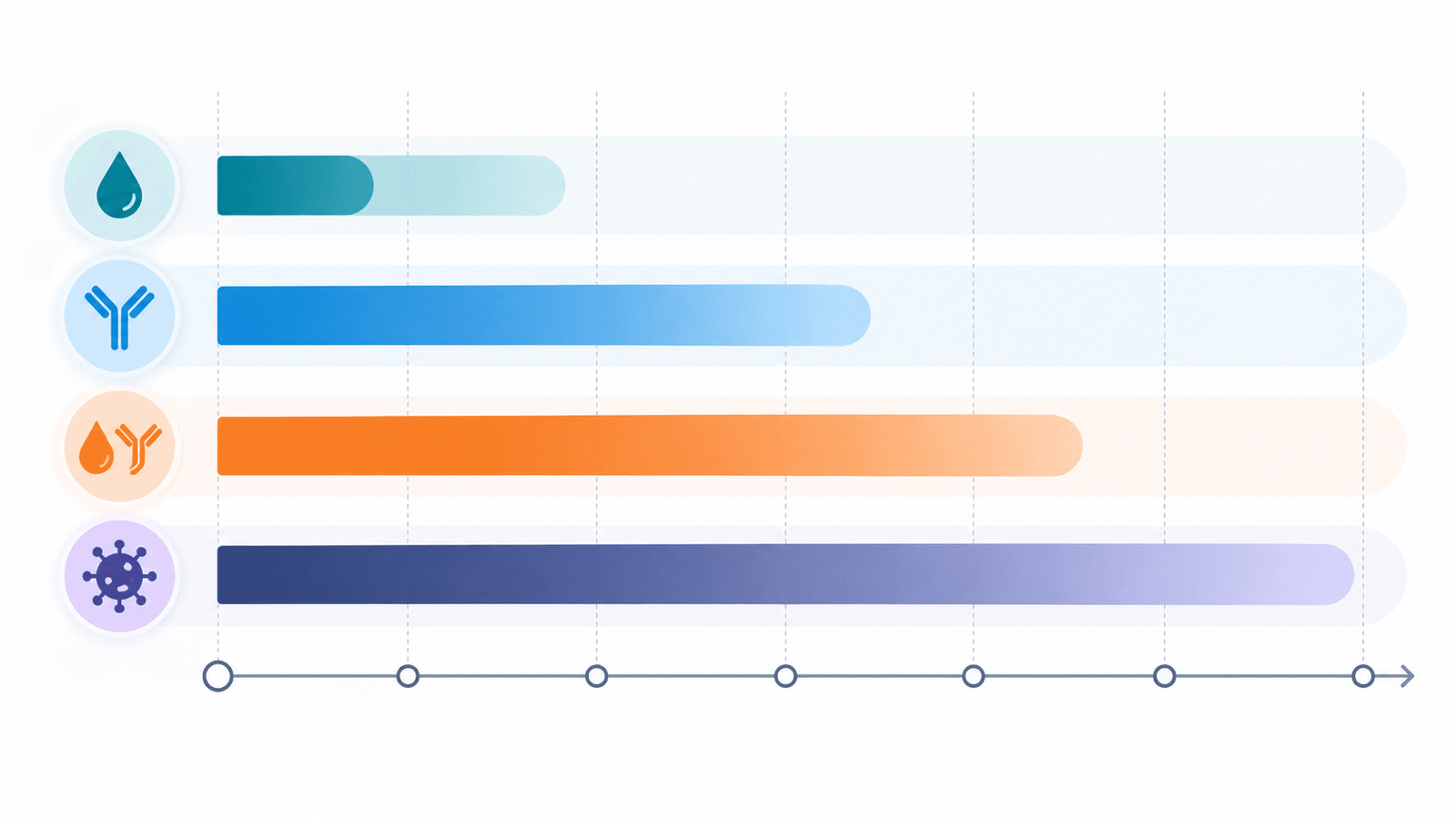
The window period is the time between a possible exposure and the point when a particular test can usually detect HIV. The ranges below come from CDC guidance (reviewed 20 October 2026). They apply in the absence of antiretroviral medicines. PrEP or PEP use may delay detection.
Test type | What it detects | Typical sample or setting | Usual detection window after exposure* | What to ask or do next |
|---|---|---|---|---|
Antibody test | Antibodies to HIV | Blood or oral fluid, depending on the assay; used in point-of-care and self-test formats | 23–90 days | Ask which assay and sample are used. If you test before the end of the range, ask whether and when to repeat. |
Laboratory antigen/antibody test | HIV antigens and antibodies | Blood drawn from a vein and tested in a laboratory | 18–45 days | Confirm it is a vein-draw laboratory test. Do not assume this range applies to a finger-stick test. |
Finger-stick antigen/antibody test | HIV antigens and antibodies | Finger-stick blood, often in a point-of-care setting | 18–90 days | Ask what follow-up is advised after a negative result taken within the range. |
Nucleic acid test (NAT) | The virus itself | Blood sample, arranged through a healthcare provider or laboratory | 10–33 days | Ask whether NAT suits your circumstances and how the result will be read alongside exposure timing and any antiretroviral use. |
*Usual ranges, not individual guarantees. Source: CDC and HIV.gov HIV testing guidance.
Expert tip: Ask the provider for the exact test name, the sample type and the window period for that assay. A label such as “rapid test” does not tell you enough.
This is an invented example that shows how to count days. It is not a prediction for any individual.
Step | Detail |
|---|---|
Possible exposure | 1 June |
Test taken | 21 June, laboratory antigen/antibody test on vein blood |
Days elapsed | 20 |
CDC usual range for this test (without antiretrovirals) | 18–45 days |
What that means | The test was taken within the range but before its end. A negative result at day 20 does not, by itself, show the person is beyond the window period. |
Sensible next step | Ask the clinician whether and when to repeat, especially if PrEP or PEP was used. |
Educational, not diagnostic. It cannot give an individual result.
Your situation | What it means | What to do |
|---|---|---|
Possible exposure within 72 hours | You may be inside the PEP window | Seek urgent clinical assessment for PEP now |
Exposure more than 72 hours ago and a test is planned or done within the test’s window | A negative result may not settle the exposure | Ask a clinician when to repeat for your exact test |
Result already received, or timing unclear | The result needs context | Take it to the test provider or a qualified clinician for interpretation and prevention planning |
Dubai offers several routes. None is “best” for everyone. Urgency, exposure timing, the exact test and your need for support all matter.
Route | Best for | Sample and result | Ask or watch for |
|---|---|---|---|
Hospital emergency department | A possible exposure within 72 hours (PEP) and urgent concerns | Clinician assessment and blood tests; PEP if appropriate | Use the words “possible HIV exposure within 72 hours.” Clinic guides describe public-hospital HIV testing as typically through clinical referral or emergency presentation, so do not assume walk-in routine screening. |
Private clinic or laboratory | Routine screening, repeat testing and talking to a doctor | Usually vein blood on a laboratory antigen/antibody test; same day to 48 hours advertised | Exact assay, total fee, result delivery, follow-up consultation |
Rapid test at a clinic (point-of-care) | A quick initial answer | Finger-stick or oral fluid; CDC says most point-of-care tests take less than 25 minutes | Finger-stick windows can be longer. A reactive result needs follow-up testing. |
Home blood collection by a licensed nurse | Privacy and convenience | Blood drawn at home and sent to a laboratory; same day to 48 hours advertised | Visit fee, which laboratory is used, who receives the result, how a reactive result is handled |
Self-test kit (pharmacy or online) | A private first check when nothing is urgent | Finger-stick or oral fluid; HIV.gov says results can come within 20 minutes | Most rapid and self-tests are antibody tests. A reactive result needs a provider. Check expiry date and instructions. |
A word on self-test kits in Dubai. Several online sellers market kits as “FDA/CE approved,” “4th generation” or “99.8% accurate in 5 minutes.” Those are seller claims. This guide cannot verify the regulatory status of an individual kit. Read the box for the window period, follow the manufacturer’s collection and reading time exactly, and remember that an invalid result is not a usable answer.
We checked provider pages on 20 October 2026. These are advertised prices from the providers themselves, not verified invoices, and they change.
Source | What was advertised | Advertised turnaround | Page timing |
|---|---|---|---|
Doctors Clinic Diagnostic Center (DCDC), Dubai Healthcare City | HIV screening from AED 249 on a 4th-generation antigen/antibody assay (cost page). Its STD guide lists a 4th-generation HIV test from AED 150. | Within 24 hours (cost page); same day (STD guide) | Clinic blog pages, mid-2026 |
Enfield STD Clinic | Basic 4th-generation screen AED 149–200; rapid test AED 209–270 | About 4 hours; about 15 minutes | Price page, early 2026 |
Medilife Home Care (home collection) | 4th-generation test from AED 199; early-detection HIV RNA PCR AED 1,299 | 6–12 hours (4th generation); 24–48 hours (RNA PCR) | Page indexed September 2026 |
SureTestKit (online kit seller) | Self-test kits AED 89–145 | Minutes, per product instructions | Seller page, early 2026 |
DCDC’s own market estimate | Private hospitals AED 200–500 for a 4th-generation test; early-detection testing typically AED 500–1,200 | Same day to 48 hours | Clinic blog, 2026 |
How to read these numbers
The CDC note that most U.S. HIV tests are free or reduced cost applies to the United States. Do not apply it to Dubai.
What the law says. UAE Federal Law No. 14 of 2014 on the Control of Communicable Diseases is active and took effect on 30 December 2014. In the English text on the UAE Legislations portal, people with communicable diseases are entitled to confidentiality of their disease-related information. The law also defines “anonymous testing,” leaves its detailed rules to the Executive Regulation, and directs the Ministry to maintain a national register for monitoring communicable diseases. The portal notes that the Arabic text prevails.
What that means in practice. A clinic advertising a “confidential” test is not telling you whether your result is identified, anonymous or reportable. Before you test, ask:
Residency medical screening. If you are applying for or renewing a UAE residence visa, HIV is among the infections covered by the mandatory medical fitness test, according to UAE-focused news and legal commentary. A voluntary private test is a personal health decision. It does not replace or change that official process, and UAE legal commentary says a positive result in the official process can have immigration consequences. For your own situation, speak to the relevant authority or a qualified UAE lawyer. This guide gives general health information, not legal advice.
If you do test positive, the first step is medical: confirmatory testing and a conversation with a clinician.
Ready-to-use booking script: “I’m seeking an HIV test. Which test do you offer, what sample is used, when can it detect infection after exposure, what is the total cost, and how will you contact me with the result?”
Illustrative scenario (not a real patient story). Maya called a clinic after realising she did not know what “HIV blood test” meant on the booking page. She asked whether the sample was drawn from a vein, which test was used, and when a negative result might need follow-up. The receptionist explained that the clinic would clarify the test and result process before booking. Maya wrote down the possible exposure date and asked how the result would be delivered before choosing an appointment.
The lesson: arrive with the exposure date and your questions, instead of choosing a test by name or speed alone.
Self-testing is popular because it is private and quick, and WHO’s 2024 consolidated guidelines on differentiated HIV testing services highlight an expanding role for self-testing and network-based testing, plus integration with STI services. It is not suited to every situation or timing concern. If your possible exposure was within 72 hours, go to urgent assessment first. If the exposure falls inside the kit’s window period, a negative result may not settle it. A reactive self-test needs follow-up testing with a healthcare provider.
Result | What it means | Next step |
|---|---|---|
Negative | The test did not detect HIV at that time. It may not settle a recent exposure if taken within the test’s window period. | Ask when to repeat for your exact test and exposure date. If exposure continues, discuss a retesting schedule and prevention options such as PrEP. |
Reactive or “preliminary positive” | An initial screening result, not a confirmed diagnosis. | A positive self-test or point-of-care test should be followed by testing through a healthcare provider. A positive laboratory test is usually followed by supplemental testing on the same sample. Contact the test provider or a clinician for clear instructions. |
Invalid or unclear self-test | The test did not produce a usable answer. It is neither negative nor positive. | Follow the manufacturer’s instructions for what to do next, or contact a healthcare provider. Repeating at home is not always the right step. |
Confirmed positive | HIV infection has been confirmed. It does not mean AIDS. | See a clinician about care. Ask the confirming provider about privacy, reporting and follow-up in your situation. |
Symptoms, or a lack of them, do not determine HIV status.
These are CDC recommendations in a U.S. context. Readers elsewhere should follow local guidance and discuss individual circumstances and frequency with a provider.
Group | CDC recommendation |
|---|---|
Everyone aged 13–64 | Test at least once |
People with certain risk factors | Test at least once a year |
Sexually active gay or bisexual men | May benefit from testing every 3–6 months |
Pregnancy | Test during each pregnancy |
People taking PrEP | Regular HIV testing is part of PrEP care |
A single negative result does not cover future exposures. If you have continuing exposure risk, talk to a healthcare professional about a testing schedule and prevention options, including PrEP. Availability and prescribing arrangements in Dubai vary, so ask a physician.
Myth | Fact |
|---|---|
“I have no symptoms, so I’m fine.” | Symptoms, or their absence, cannot confirm or rule out HIV. Only testing can. |
“A negative test on day 5 settles it.” | Even the NAT usual window starts at 10 days. A very early test can be too early. |
“A rapid test is always the quickest route to certainty.” | Rapid results still need follow-up if reactive, and finger-stick windows can be longer. |
“Confidential means nothing is ever reported.” | UAE law covers confidentiality and national monitoring. Ask the provider how it works. |
No. An HIV test is the test used to find HIV infection. AIDS is an advanced stage of HIV infection, not a separate infection, and no symptom, or lack of symptoms, can confirm or rule out HIV. Ask a clinician which HIV test fits your exposure date.
It depends on the test. CDC’s usual ranges, without antiretroviral medicines, are 10–33 days for a NAT, 18–45 days for a laboratory antigen/antibody test on vein blood, 18–90 days for a finger-stick antigen/antibody test, and 23–90 days for an antibody test.
In provider pages reviewed on 20 October 2026, standard HIV screens were advertised from about AED 149 to AED 500, and early-detection RNA testing at roughly AED 500–1,299. These are provider-published prices that change, so ask for the total fee, including consultation or home-visit charges, before booking.
Advertised timelines ranged from about 15 minutes for rapid tests to same day or 24–48 hours for laboratory tests. A reactive rapid or self-test needs follow-up testing. Ask which test is used and how the result will be delivered.
UAE Federal Law No. 14 of 2014 gives people with communicable diseases a right to confidentiality of related information, and it also provides for a national register to monitor such diseases. Confidential therefore does not automatically mean unreported. Ask the provider how identification, reporting and result access work.
Self-test kits and home blood-collection services are advertised in Dubai. Most rapid and self-tests are antibody tests with longer windows, and a reactive result needs follow-up with a healthcare provider. Check the kit’s instructions, expiry date and window period, or choose a clinician-led home visit.
Contact a healthcare professional or go to a hospital emergency department as soon as possible to ask about PEP. HIV.gov says PEP must start within 72 hours and works best when started as soon as possible. A routine screening appointment is not a substitute.
Not necessarily. A negative result means the test did not detect HIV at that time. If it was taken inside the test’s window period, ask a clinician when to repeat it, especially if PrEP or PEP was used.
It is an initial screening result, not a final diagnosis. A positive self-test or point-of-care test should be followed by testing through a healthcare provider, and a positive laboratory test is usually followed by supplemental testing on the same sample.