
In a city that never sleeps, new parents in Dubai often find themselves in a paradox: surrounded by world-class amenities, yet utterly alone during the most vulnerable weeks of parenthood. For expat families without grandparents or extended relatives nearby, the newborn phase can feel like a relentless cycle of exhaustion, anxiety, and self-doubt.
This guide is your roadmap to understanding, hiring, and benefiting from home nursing and night nurse services in Dubai. Whether you’re a first-time parent desperate for a full night’s sleep, a working professional juggling childcare and a demanding career, or a family seeking compassionate care for an elderly relative, you’ll find clear, actionable answers here. We’ll demystify the roles, break down real costs, and walk you through every step, from verifying a DHA license to preparing for the first night.
By the end, you’ll know exactly which type of caregiver fits your needs, how much to budget, and how to hire with confidence. You’ll gain the peace of mind that comes from making an informed decision, and you’ll reclaim the rest and recovery you deserve.
Let’s begin.
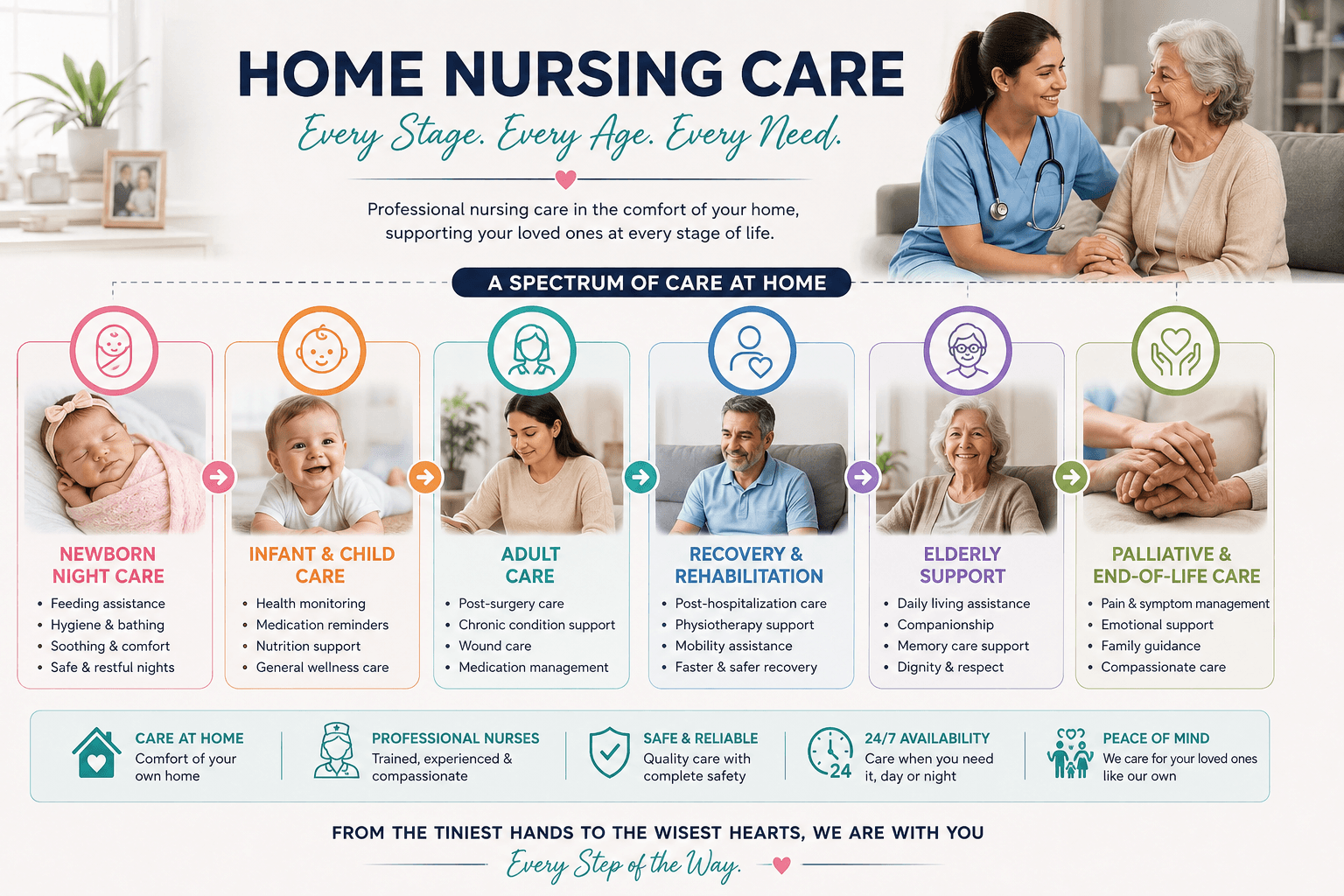
What it covers: Overnight support for newborns, feeding (bottle, or bringing baby to mother for breastfeeding), burping, diaper changes, soothing, and establishing sleep routines. The caregiver stays awake to monitor the baby so you can sleep.
Who provides it: A night nanny, a home nurse for newborns, or a maternity nurse, depending on the level of medical expertise your family needs.
Ideal for: Parents in the first 0–6 months, especially those recovering from childbirth, dealing with sleep deprivation, or without family support nearby.
Expert tip: A night nurse with newborn care training can also spot early signs of jaundice, feeding issues, or other concerns, an extra layer of safety, not just an extra pair of hands.
What it covers: Medical and non-medical support for someone recovering from surgery, injury, or illness at home. Wound care, medication management, mobility assistance, and vital-sign monitoring.
Who provides it: DHA-licensed home nurses with clinical experience.
Ideal for: Patients discharged after orthopedic, cardiac, or cosmetic surgery, or anyone needing short-term rehabilitation support.
What it covers: Long-term or respite care for seniors: help with bathing, dressing, meal preparation, medication reminders, companionship, and monitoring of chronic conditions like diabetes or hypertension.
Who provides it: Home nurses or trained caregivers, often with geriatric care experience.
Ideal for: Families caring for aging parents at home, especially when managing several health needs at once.
When discussing medical care for an elderly parent, always work from a physician’s care plan and check that the agency follows DHA’s home healthcare guidelines. This isn’t paperwork for its own sake. It’s what keeps everyone accountable if something goes wrong.
What it covers: Overnight care for children with special needs, chronic illnesses, or medical equipment (feeding tubes, monitors). The nurse ensures safety, administers medications, and responds to emergencies.
Who provides it: Pediatric home nurses with specialized training.
Ideal for: Families with medically fragile children who need continuous overnight monitoring.
This is the single most confusing part of the search, so let’s settle it clearly.
Night Nanny — Focuses on general overnight childcare: feeding, diapering, soothing. No medical training. May also handle light tasks tied to the baby, washing bottles, tidying the nursery. Best for parents who need a reliable extra pair of hands and a full night’s sleep, without clinical oversight.
Home Nurse for Newborns — A DHA-licensed nurse with clinical training in newborn care. Can monitor vital signs, recognize early signs of illness, and support breastfeeding. Often works nights but may also provide 24-hour care. The right choice for preemies, multiples, or medical concerns.
Maternity Nurse — A specialized professional, often holding certifications like MNT (Maternity Nurse Training) or Norland, who provides intensive care for mother and newborn during the first weeks. Guides feeding, sleep routines, and postpartum recovery. Typically lives in or works extended shifts, and commands the highest rates of the three.
Expert tip: Always verify a DHA license directly through DHA’s Sheryan portal (
services.dha.gov.ae/sheryan), under “Verify Professional License/Registration Status.” It’s free and takes a few minutes. A genuine professional will never object to being checked.
If you’re still unsure, start by writing down what you actually need help with: sleep, medical monitoring, or a full recovery plan. The answer to that question usually points straight to the right role.
Rates vary by agency, caregiver qualification, and how far in advance you book. Below is a realistic range compiled from current Dubai market data as of August 2026.
| Caregiver Type | Hourly Rate (AED) | Night / Daily Rate (AED) | Monthly Rate (AED) | Typical Qualifications | Best For |
|---|---|---|---|---|---|
| Night Nanny | 30–70 (55–100 for newborn-specific care) | ~400–700 per night shift | 1,500–4,000 (live-in), 3,000–6,000+ (live-out) | Childcare experience, first aid/CPR; no medical license required | Healthy newborns, parents who need sleep support without clinical needs |
| Home Nurse for Newborns | 80–250 | 570–1,600 per night shift | 19,000–30,000 (full-time/live-in) | DHA-licensed nurse; often with neonatal or pediatric training | Preemies, multiples, medical concerns, parents who want clinical oversight |
| Maternity Nurse (MNT/Norland) | Rarely offered hourly; typically packaged | 700–1,200 (estimated, where day rates exist) | 15,000–30,000 (live-in) | MNT, Norland, or equivalent certification; often live-in | 24/7 expert care, postpartum recovery, sleep training |
A note on that maternity nurse row: unlike night nanny and home nurse rates, day and hourly pricing for MNT/Norland-certified maternity nurses isn’t consistently published. Most agencies quote a monthly live-in package. Ask directly for a day-rate breakdown if you only need short-term support.
If you take away one number from this table, take this: the cheapest hourly rate is rarely the cheapest total cost. A licensed agency hire with a replacement guarantee often costs less in stress and risk than a bargain independent hire that falls through in week two.
Write out a short, specific list. Do you need medical support or just childcare? What hours? How many nights a week? Any language or cultural preferences? Then set a realistic budget range using the table above, and talk it through with your partner, especially around privacy and household routines.
Expert tip: Start your search two to three months before your due date. The best night nurses and maternity nurses in Dubai are often booked well in advance.
services.dha.gov.ae/sheryan) and find “Verify Professional License/Registration Status.”For maternity nurses, ask to see original MNT or Norland certificates, not photocopies of photocopies. For home nurses, confirm neonatal or pediatric training specifically, a general DHA license doesn’t guarantee newborn specialization.
Go beyond “tell me about your experience.” Ask scenario-based questions: What would you do if the baby wouldn’t stop crying for an hour? How do you handle a sudden fever in a newborn? Ask how they’ll update you each morning, verbally, a written log, or both. A caregiver who answers with specifics, not platitudes, is one worth trusting.
This is not optional if you’re hiring for anything longer than a few nights. Watch punctuality, hygiene, how they respond to your instructions, and how your baby reacts. Reluctance to follow your care plan, or a dismissive attitude when you ask questions, is a red flag worth taking seriously, even if everything else looks good on paper.
Prepare a written care plan in advance: feeding preferences, sleep routines, emergency contacts, and any specific instructions. Share it before the trial begins, not after.
Use a written, MoHRE-compliant contract that specifies duties, working hours, salary, rest days, and termination terms. If hiring independently, you’ll handle visa sponsorship yourself; agencies typically manage this as part of their fee. Either way, confirm the caregiver has valid health insurance before their first shift.
The Dubai Health Authority governs all healthcare professionals and facilities operating in Dubai, including home healthcare services. It sets the educational, clinical, and ethical standards a nurse must meet before she’s allowed to practice, and requires ongoing affiliation with a DHA-approved facility. A nurse cannot legally freelance as an independent clinical practitioner under a DHA license; she must be sponsored by, and accountable to, a licensed facility.
If a nurse or agency hesitates when you ask to do this, that hesitation is the most useful piece of information you’ll get all day.
Under UAE law, home nurses, nannies, and maternity nurses working inside your household fall under Federal Decree-Law No. 9 of 2022 Concerning Domestic Workers (amended by Federal Decree-Law No. 21 of 2023), a separate framework from standard private-sector labor law. Key protections you’re legally required to provide:
If you hire through an agency, the caregiver is typically employed by the agency, which handles licensing, visa, and insurance; you pay the agency directly, and most of this compliance burden sits with them. If you sponsor independently, all of it sits with you.
Uninterrupted sleep speeds recovery from childbirth, vaginal or C-section. It reduces inflammation, supports hormonal balance, and lowers the risk of postpartum complications. A rested mother also tends to establish breastfeeding more successfully: the night nurse brings the baby to you for feeds, then handles burping and settling, so you go straight back to sleep instead of staying up for the full routine.
Sleep deprivation is one of the strongest known contributors to postpartum mood difficulties. Consistent night support doesn’t eliminate that risk, but it removes one of the heaviest contributing factors. Many parents also describe a drop in the constant hypervigilance of the newborn phase, simply knowing a trained professional has eyes on the baby lets the nervous system stand down, even briefly.
If you notice persistent low mood, intrusive worry, or a sense of disconnection that doesn’t lift with rest, that’s worth raising with your doctor directly. A night nurse supports recovery. She isn’t a substitute for medical care if something deeper is going on.
A consistent overnight routine, set early and held steady, supports healthy sleep habits and can ease the adjustment for the whole family. A trained night nurse is also positioned to notice early signs of reflux, feeding difficulty, or illness before they escalate, and to flag them for your pediatrician promptly.
When parents are rested, the small things stop becoming arguments. Energy is freed up for older siblings, who often feel the disruption of a new baby more than adults realize. None of this is about outsourcing parenting. It’s about having enough left in the tank to actually be present for it.
A caregiver from a different background may have different instincts around feeding, swaddling, or infant routines. Address this openly in the interview, not after a misunderstanding happens. Use the trial shift to gauge real compatibility, and ask agencies directly whether they can match on language or cultural fit if that matters to you.
This can feel intrusive, especially when you’re exhausted and emotionally raw. Set boundaries from day one: a designated resting space for the nurse, clear house rules, and a shared understanding of what “quiet hours” mean in your home. A baby monitor lets you stay connected without needing the nurse in your bedroom.
Assumptions cause more friction than actual mistakes do. Write a short, specific care plan covering duties, routines, and house rules, and go through it together on the first night. A simple shared log for feeds, diapers, and sleep keeps everyone on the same page and removes the need for awkward morning debriefs.
Have a clear protocol before the first shift: emergency numbers, your pediatrician’s contact, the nearest hospital, and confirmation that the nurse is trained in infant CPR and first aid. Ask her to walk you through what she’d actually do in a specific emergency scenario during the interview. A confident, specific answer tells you far more than a certificate does.
Trust your instincts here, more than almost anywhere else. If you’re working with an agency, most offer a replacement within a guarantee period; use it without guilt. If you hired independently, make sure your contract includes a clear termination clause from the start. Your baby’s safety and your own peace of mind come before any sense of obligation to make an arrangement work that isn’t working.
The scenarios below are composites, drawn from common patterns families describe to agencies and in Dubai parenting communities, not individual case files. They’re included to show how the decision actually plays out in practice.
Premature twins, no family nearby. An expat couple welcomed twins early. With one parent back at work within the week and no relatives in the country, the exhausted mother was recovering from a C-section on roughly two hours of broken sleep a night. They brought in a DHA-licensed home nurse for newborns six nights a week for the first three months. The nurse managed all night feeds, tracked weight gain for both babies, and coached tandem feeding techniques. Recovery accelerated, and the twins settled into a shared sleep rhythm by around twelve weeks.
A working parent and postpartum anxiety. A mother returned to a demanding job four months postpartum but found herself waking repeatedly through the night to check on the baby, even on nights her partner was on duty. The family brought in a maternity nurse for four weeks to run a structured sleep routine and provide steady overnight reassurance, with a written log sent each morning. Seeing consistent evidence that the baby was thriving helped ease the anxiety, and sleep, and focus at work, gradually returned.
Caring for an elderly parent with early dementia. An adult child working full-time was also managing his mother’s nighttime wandering and confusion. A home nurse with geriatric experience took over five night shifts a week, ensuring medication adherence, providing companionship, and establishing a calming bedtime routine. Nighttime agitation decreased, sleep improved for both of them, and daytime caregiving became far more sustainable.
Every family’s situation is different. What these scenarios share is a simple pattern: the right kind of help, matched to the actual problem, changes what’s sustainable.
How much does a night nurse cost in Dubai? It depends heavily on which role you need. A night nanny typically runs AED 30–70 an hour (higher for newborn-specific care), a DHA-licensed home nurse for newborns runs roughly AED 570–1,600 per night shift, and maternity nurses are usually priced as a monthly live-in package, generally AED 15,000–30,000. See the cost table above for the full breakdown.
How far in advance should I book? Start two to three months before your due date if possible. Maternity nurses and highly experienced night nurses are often booked out well ahead of time. Some agencies offer same-day placement for last-minute needs, but your choice of caregiver will be more limited.
What qualifications should I actually look for? A DHA-licensed home nurse must hold an active, verifiable DHA license. A maternity nurse should hold MNT, Norland, or equivalent certification. A night nanny doesn’t need a medical license but should have genuine childcare experience and a first aid/CPR certificate.
Can a night nurse support breastfeeding? Often, yes. A skilled night nurse can bring the baby to you for feeds, help with latching, then handle burping and settling so you go straight back to sleep. Some are also trained lactation counselors. Confirm this specifically during the interview if it matters to you.
What if the night nurse gets sick or doesn’t show up? Agencies typically provide a replacement, often within hours. If you’ve hired independently, build a backup plan in advance, an on-call list from an agency, or a trusted contact who can step in.
Is it safe to have someone in my home overnight? Reputable agencies conduct background checks, and DHA licensing adds a layer of accountability that independent, unverified hires don’t have. Use the trial shift to build real trust, and disclose any monitoring devices to the caregiver, as required under UAE privacy norms.
Do I need to sponsor a visa? Only if you’re hiring a live-in caregiver directly, outside an agency. That requires a MoHRE-registered contract, a medical fitness test, and health insurance. Agencies typically employ the caregiver under their own sponsorship, which simplifies this considerably.
What’s the real difference between a night nurse and a night nanny? A night nurse, in the clinical sense, is DHA-licensed and trained to handle medical tasks. A night nanny provides skilled, experienced childcare without clinical authority. Choose based on your baby’s actual health needs, not on which title sounds more reassuring.
You don’t need to buy software for any of this, a shared document does the job:
If it would help, I can build any of these, the cost worksheet, the interview checklist, or a contract template, as a standalone document you can fill in and reuse.
Bringing a night nurse or home caregiver into your life is a deeply personal decision, but for many Dubai families without a support network nearby, it’s a transformative one. It isn’t just about buying sleep. It’s about protecting your health, supporting your baby’s development, and holding onto the parts of parenthood, or caregiving, that actually feel good, during weeks that can otherwise feel like survival.
With the right information, a clear budget, and a properly verified professional, you can make this decision with confidence instead of guesswork.
You don’t have to do this alone.
This guide is intended as general information for families researching home nursing and night nurse options in Dubai. Costs and regulations change; always verify current rates directly with agencies and confirm any nurse’s license status through DHA’s official Sheryan portal before hiring.