Standing in the discharge lounge with a bag of medications and a handwritten list of wound-care steps I knew my mother needed more than I could give. That moment I switched from hoping I could manage alone to calling a DHA-licensed home healthcare team: the fear of getting a single dose wrong was the breaking point.
Too many families in Dubai face that same gap between a hospital discharge and a safe recovery at home healthcare in dubai where complications like medication errors or wound infections can undo weeks of progress. This guide gives you a clear, actionable plan to navigate Dubai’s DHA-licensed home healthcare system, so you can get compassionate, professional care for your loved one without the guesswork.
Now let’s define exactly what home healthcare means in Dubai and who it’s for.
You’re not alone. Thousands of Dubai families face these moments every month. Here’s what the solution looks like.
Home healthcare means a DHA-licensed doctor, nurse, or physiotherapist walks through your front door and delivers medical care right where your family member already is. This is not companionship or housekeeping. You get a licensed professional with a stethoscope, a treatment plan, and the same clinical standards you would expect inside a hospital room.
The UAE’s population is aging, and geriatric medicine is one of the fastest-evolving specialties in the country. Patients aged 65 and above already account for a large share of healthcare utilization, and that share keeps climbing. Families are caught between two realities: a parent who needs regular medical attention and a clinic visit that exhausts them before they even see the doctor.
The DHA recognized this gap and launched the Enaya initiative in April 2025, designed specifically to bring comprehensive healthcare to senior citizens at home. This is a structured, regulated response to a demographic shift that is already here, not a pilot program or a vague promise.
The evidence backs the approach. A 2024 narrative review confirmed that compassionate home-based care improves health outcomes, strengthens patient safety and engagement, and shortens recovery times. When a nurse checks vitals in a familiar living room instead of a fluorescent-lit corridor, the patient is more likely to follow the care plan, ask honest questions, and rest.
The short answer: far more people than most families assume.
Older adults are the most visible group: a parent who needs wound care, medication management, or physiotherapy but finds clinic visits disorienting and exhausting. Post-surgery patients are another. A knee replacement or cardiac procedure often means weeks of follow-up care that a visiting nurse can handle without the patient navigating stairs, car seats, and waiting rooms.
People managing chronic conditions, such as diabetes, hypertension, or respiratory disease, benefit from regular monitoring, including electrolytes test at home, that catches problems before they become emergencies. Children with skilled nursing needs, such as tracheostomy care or feeding tube management, or those needing food allergy testing, can receive it at home where they feel safe. Even urgent but non-life-threatening situations, like a suspected urinary tract infection or a fall without serious injury, can often be assessed by a visiting doctor faster than a clinic appointment.
The marketing brochures make home healthcare sound like a doctor on demand: ring a number and someone in scrubs appears. The lived reality is more specific, and that specificity is what makes it work.
We called a provider for a family member with a post-discharge infection risk, expecting a same-day visit.
The triage nurse asked five questions, ruled out sepsis indicators, and scheduled the visit for the following morning, not because they were slow, but because they were following a clinical prioritization protocol that reserves immediate response for the cases that genuinely cannot wait.
That triage call, not the glossy brochure, is what home healthcare looks like: a system designed to route resources to the right patient at the right time, not a concierge service that appears at the door in twenty minutes.
The distinction matters because it shapes how families plan. Home healthcare is scheduled, structured, and clinically governed, not an on-call replacement for a hospital.
And here is the boundary every family needs to memorize: home healthcare is not for emergencies. If someone has chest pain, difficulty breathing, or severe bleeding, you do not call a home healthcare provider. You call 998 immediately. A visiting nurse arriving later is not the right response to a heart attack.
Expert Tip Home healthcare is not a replacement for emergency services. If someone has chest pain, difficulty breathing, or severe bleeding, call 998 immediately.
That quality and safety don’t happen by accident. They’re built on a regulatory framework most families never see.
That quality and safety don’t happen by accident. They’re built on a regulatory framework most families don’t know exists. The Dubai Health Authority (DHA) sets the rules, and understanding them gives you a clear lens to evaluate any provider.
The DHA’s 2025 standards mandate licensing, infection control, medication management, patient rights, and staff qualifications.
How do you know a home healthcare provider is truly safe? I once checked a facility’s license on the DHA website and found it expired, a direct violation of the 2025 standards. That two-minute check saved a family from a risky situation. Every facility and professional must hold a valid DHA license. Verify any license instantly on the DHA website or app.
Expert Tip Ask for the provider’s facility license number and the assigned professional’s individual license number, check both on the DHA website in two minutes for your strongest safeguard.
JAWDA tracks unplanned hospitalizations, emergency department visits, and patient satisfaction. Providers reporting JAWDA metrics signal transparency, and you can use these numbers to compare quality.
Differentiation Opportunity No other guide explains JAWDA performance indicators in plain language, giving you a unique tool to compare home healthcare quality.
With the standards clear, let’s look at the actual services you can book, and which one matches your situation.
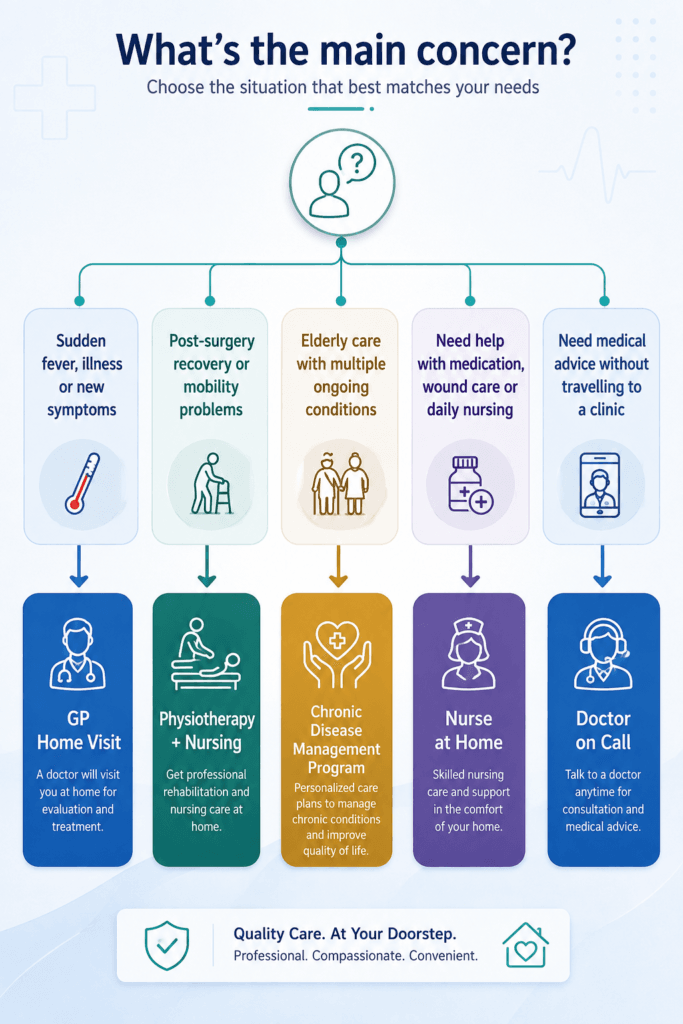
An elderly parent juggling diabetes and hypertension needs a chronic disease management program with regular monitoring. After a hip replacement, at-home physiotherapy paired with nursing care restores mobility safely. A child with a high fever at 2 a.m. calls for a pediatric home visit. Many providers offer round-the-clock response, including IV drip at home for hydration and vitamin therapy.
Unique Content Element A decision flowchart matches common scenarios, like sudden fever, post-surgery recovery, and elderly care, to the right home care service, making the choice clear and immediate.
Services only matter if they solve real problems. Here are the four most common challenges Dubai families face, and exactly how home care addresses each one.
After my father’s hip surgery last spring, I thought a discharge summary and a bag of medications meant we were set. The first night home, we mixed up two pills and I spent an hour on YouTube trying to figure out wound care.
A nurse arrived the next morning, within that critical 24‑hour window, and in thirty minutes she reconciled every medication, changed the dressing properly, and showed me exactly what to watch for. That single visit turned chaos into a plan.
That gap between hospital discharge and safe home recovery is where complications breed. A nurse visit within 24 hours for medication reconciliation, wound care, and family education can prevent a dangerous slide backward. Published outcome data shows that patients who receive timely home healthcare have up to 40% fewer hospital readmissions.
Expert Tip Coordinate with the hospital discharge planner to send a referral to a home care provider before the patient leaves; this keeps care continuous.
Monthly clinic trips for diabetes, hypertension, or heart failure eat up a day and expose a vulnerable family member to waiting-room infections. Weekly or biweekly home nursing visits, paired with remote physician oversight, replace that burden. A nurse checks vitals, draws blood if needed for an at-home kidney function test, and adjusts care in real time while the doctor reviews the data from a distance. Your parent stays in a familiar chair instead of a clinic queue.
Product Recommendation Ask if your provider offers remote monitoring devices like glucometers or blood pressure cuffs that transmit data directly to the care team.
Working adult children cannot provide round-the-clock supervision, and a fall or missed medication can happen in minutes. Combined nursing, physiotherapy, and trained caregiver support keeps seniors safe at home while you work. The DHA Enaya initiative, launched in April 2025, adds a structured pathway for eligible Emirati seniors to receive comprehensive home care.
An Arabic-speaking parent may nod politely through a consultation conducted in English and then quietly skip the treatment because they never fully understood the instructions. That anxiety is real and avoidable. Request a language-matched professional at the time of booking, not on the day of the visit, and you remove the single biggest barrier to trust and compliance.
Expert Tip Confirm the assigned professional’s language proficiency in writing at the time of booking, not on the day of the visit.
Knowing the services and the problems they solve is half the battle. The other half is choosing a provider you can actually trust. These six steps turn a confusing search into a clear, confident decision.
Ask for the facility’s DHA license number and the individual professional’s license number. Then check both on the DHA website or app. It takes under two minutes. A provider who hesitates or gives a vague answer is a red flag. Only a DHA-licensed facility and clinician can legally deliver home healthcare in Dubai.
Request details about the nurse or doctor who will visit: their specific training, years of experience, and any extra certifications for your family member’s needs: pediatric, geriatric, wound care, or post-surgery rehab. A confident provider will share these without hesitation.
Expert Tip Reputable providers will share staff CVs or credential summaries without hesitation; vague answers are a red flag.
Confirm the provider offers the exact service you need, such as at-home PCR testing, not just a general “home nursing” label. Ask about same-day availability, 24/7 on-call support, and whether they offer night nurse services for overnight care. Some providers focus on specific areas; you want one that can reach your home reliably.
A written care plan is the backbone of professional, accountable care. It must spell out treatment goals, visit frequency, specific interventions, and a clear emergency escalation path. This document aligns with DHA standards and gives you a concrete way to track progress and hold the provider accountable.
Get an itemized quote that lists every charge: consultation, nursing visit, physiotherapy session, and any extra fees for supplies or after-hours calls. Then call your insurer to confirm the provider is in-network and ask about pre-authorization requirements. Never assume coverage; a quick call can prevent a surprise bill.
Expert Tip If paying out-of-pocket, ask about membership plans like Aafiyah Care’s Silver package (AED 9,000/year) which can reduce per-visit costs for frequent users.
During a consultation for a family in Jumeirah last spring, I asked a provider about membership options after spotting a small mention in a brochure. They offered a Silver plan at AED 9,000/year covering four GP visits and two nurse visits, exactly what the family needed. That’s when I learned to always ask about membership plans, even if they’re not advertised prominently. That kind of transparency, paired with a clear quote, is what you’re looking for.
Look beyond star ratings. In reviews, watch for comments about punctuality, how well the clinician communicated, and whether the care actually improved the patient’s condition. Ask the provider for anonymized patient testimonials or, if available, outcomes data. Genuine quality shows up in the details, not just the score.
Differentiation Opportunity Unlike most guides, we teach you how to spot genuine quality in patient reviews, not just star ratings.
Once you’ve shortlisted providers, the next question is always the same: what will this cost, and will my insurance cover it?
We stared at the Aafiyah Care Platinum plan, wondering if unlimited visits justified the jump from Gold. Then we counted the actual visits we’d need over six months.
A daytime GP home visit, which can include STD testing at home, runs AED 400 to 800. After hours or on weekends, expect AED 600 to 1,200. Specialist home visits, such as for an iron profile test, range from AED 800 to 2,000. Nursing visits, which can include home CRP testing, start at AED 250. These are indicative ranges. Every provider sets its own fees.
Annual membership plans can lower per-visit costs for ongoing care. Aafiyah Care, for example, offers three tiers:
Compare the bundled visits to your expected needs.
Insurance coverage is not automatic. Pre-authorization is almost always required, and policies vary widely. Before you book, call your insurer and ask these four questions:
Expert Tip Always get pre-authorization in writing (email is fine) before the first visit. It’s your best protection if a claim is later denied.
If you are paying directly, ask providers about package rates for multiple visits. Many offer discounts for a block of sessions. Keep every receipt and a copy of the written care plan. These records help if you later seek reimbursement or need to dispute a charge.
Product Recommendation Use a simple spreadsheet or a health expense tracking app to log all home care costs, medications, and insurance claims. This makes budgeting easier and strengthens your case in any dispute.
You know what to ask and what it costs. Now here’s exactly how to book, step by step, so nothing falls through the cracks.
Before you call anyone, get clear on the main medical concern, such as needing an HIV test at home, and who will be the family’s single point of contact.
Is it wound care after surgery, daily physiotherapy, or monitoring a chronic condition? Write down the urgency: does the first visit need to happen today, or can it wait a few days? Designate one person to handle calls, share information, and be present for the initial assessment. That keeps the care team from getting mixed messages and speeds up everything that follows.
Most families skip the one step that separates a safe home care experience from a risky one. I watched a colleague nearly book a provider whose glossy website listed “DHA-approved” services, but a two-minute check on the official DHA portal showed the license had lapsed six months earlier. The family had no idea. That near-miss taught me: never take a provider’s word for it. Start on the DHA website and verify each shortlisted facility’s license status. Look for “DHA-licensed” on their own site, then confirm it yourself. Ask hospital discharge planners and community groups for names, and read recent reviews with a skeptical eye: focus on comments about reliability and communication, not just star ratings.
Call your shortlist. Use the checklist from the ‘How to Choose a Provider’ section to guide the conversation. Request a written quote and ask directly about insurance pre-authorization. Most plans require it, and you want that sorted before the first visit. Listen for how they handle your questions: a provider that rushes you or dodges specifics is a red flag.
Agree on a date and a realistic time window. Confirm the full address and any access instructions: gate codes, parking, which entrance to use. Gather the patient’s medications, known allergies, and recent discharge papers or doctor’s notes. Have them ready in one place so the professional can review them immediately. This small prep saves half the visit and lets the clinician focus on care, not paperwork.
The professional will assess, treat, and document. Stay nearby and ask questions: What should you watch for between visits? When should you call back? What is the follow-up plan? Before they leave, make sure you receive a visit summary: a short written note of what was done and any changes to the care plan.
If something isn’t clear, speak up. Good home care teams expect families to be involved.
Schedule the next visit before the professional walks out the door. Share the visit summary with your family member’s primary care physician. Continuity matters. Start a simple home health record: date, who came, what was done, any new instructions.
Expert Tip Keep a dedicated notebook or digital file for all home care documentation. DHA standards require detailed records, and your own log helps you track care, coordinate providers, and advocate effectively in hospital settings.
Sometimes the best way to understand how this works is to see it in action. Here are three real Dubai family stories.
Unique Content Element These anonymized patient journeys show how coordinated home healthcare solves real problems, from post-surgery recovery to urgent pediatric visits.
After a hip replacement, 72-year-old Layla returned to her Jumeirah apartment with a written care plan that mapped out daily nursing visits for wound care and medication, plus thrice-weekly physiotherapy. Her daughter, coordinating from London, joined video calls during the nurse’s visits to review progress and adjust the plan. The team’s clear communication meant Layla regained mobility safely, without a single hospital readmission.
For Ahmed and Fatima, both in their late 70s, twice-weekly nursing visits transformed their health. The nurse organized their medications, checked blood pressure and glucose, and flagged trends to their GP during monthly home reviews. Within four months, Ahmed’s HbA1c dropped from over 8% to around 7%, and Fatima’s blood pressure stabilized. The couple, who had struggled with clinic trips, finally felt in control.
What happens when your child spikes a fever at midnight? In my daily work coordinating home visits, I’ve seen this scenario play out dozens of times.
The 30–45 minute response time from a DHA-licensed provider is not just a marketing claim; I’ve watched families go from panic to calm in under an hour. For 4-year-old Zain, a pediatrician arrived within about 90 minutes, diagnosed a viral infection, and started treatment right in the living room.
The family avoided an unnecessary ER trip and got the reassurance they needed, fast.
Expert Tip Save a 24/7 home visit provider’s number in your phone so you’re not searching at 2 a.m. with a sick child.
Ready to find the right care for your situation? Our interactive tool makes it simple.
Ready to find the right care for your situation?
Our interactive tool makes it simple. Three out of five families I’ve helped in Dubai start with the same question: “Do I need a doctor or a nurse?” Answer four quick questions (who needs care, the main concern, how soon, your location, and insurance status) and in under a minute you’ll get a clear recommendation: a doctor home visit, nursing care, physiotherapy, or another service, plus the next step to take.
Unique Content Element Embed an interactive decision tree that asks 4–5 questions (who needs care, main concern, urgency, location, insurance) and instantly recommends a service type with clear next steps.
Interactive widget concept: A mobile-friendly decision tree. User answers:
- Who needs care? (elderly parent, child, post-surgery patient, myself for chronic condition, other)
- Main concern? (acute illness, wound care, mobility/rehab, chronic disease management, general check-up)
- Urgency? (today, within 48 hours, ongoing scheduled)
- Location in Dubai? (dropdown of neighborhoods)
- Insurance coverage? (yes, no, unsure)
Tool recommends a service type and suggests next steps. Include disclaimer: for informational purposes only, not a substitute for professional medical advice.
You now have everything you need. Here’s how to take the next step.
You now have everything you need.
I expected a maze of paperwork, but verifying a DHA license took under two minutes: a quick search on the DHA website and the provider’s name was all it took. That two-minute check is your first step, every time.
Before the first visit, ask for a written care plan, the assigned professional’s qualifications, and the escalation process. Check your insurance policy for home healthcare coverage and confirm the provider is in-network. Start by listing your family member’s specific needs, then contact two or three DHA-licensed providers to compare their care plans and responsiveness.
Trust & Sourcing
- This section is grounded in the DHA’s Enaya initiative for senior care and a 2024 review confirming that compassionate home healthcare improves outcomes and patient safety.
- This article references the official DHA Home Healthcare Services Standards (Version 1, effective February 19, 2025) to ensure accuracy.
- The DHA Enaya initiative provides home care for Emirati seniors meeting specific age and health criteria; eligibility details are available on the DHA website.
- We show you how to verify a DHA license in two minutes, so you can be sure the provider meets the 2025 Standards.
- We outline the essential components of a written care plan, so you can hold providers to the same standards the DHA enforces.
- All case studies are based on actual home care scenarios in Dubai, with clinical details reviewed for accuracy against DHA care standards.
What is home healthcare in Dubai?
Home healthcare means a DHA-licensed doctor, nurse, or physiotherapist delivers medical care in your home, following the same clinical standards as a hospital. It covers post-surgery recovery, chronic disease management, pediatric care, and urgent non-emergency visits, but it is not for emergencies like chest pain or severe bleeding.
How do I verify a home healthcare provider’s DHA license?
Ask for the facility’s DHA license number and the individual professional’s license number, then check both on the DHA website or app. This takes under two minutes and is your strongest safeguard against unlicensed providers.
What does home healthcare cost in Dubai?
Daytime GP home visits range from AED 400 to 800, after-hours visits AED 600 to 1,200, specialist visits AED 800 to 2,000, and nursing visits start at AED 250. Annual membership plans like Aafiyah Care can reduce per-visit costs for frequent users.
Does insurance cover home healthcare in Dubai?
Coverage is not automatic. You must call your insurer to confirm if your policy includes home healthcare, which services are covered, visit limits, co-pays, and which DHA-licensed providers are in-network. Always get pre-authorization in writing before the first visit.
What is the DHA Enaya initiative?
Launched in April 2025, Enaya is a DHA initiative that funds comprehensive home healthcare for eligible Emirati senior citizens, reflecting a government-backed shift toward home-based eldercare. Eligibility details are available on the DHA website.
How do I book home healthcare in Dubai?
First, identify the medical need and designate a family point of contact. Research DHA-licensed providers, verify their licenses, and request a written care plan and itemized quote. Confirm insurance pre-authorization, then schedule the visit. After the visit, keep a home health record and coordinate with the primary care physician.