
You’re a parent in Jumeirah, juggling school drop-off and a work call. Your doctor ordered a CRP test. The clinic visit means traffic on Sheikh Zayed Road, circling for parking, and a waiting room full of patients. A ten-minute blood draw just cost you half a day. Home CRP testing offers a clinically equivalent alternative, with DHA-licensed phlebotomists bringing the lab to your doorstep through home collection.
KEY TAKEAWAYS • Home CRP testing in Dubai matches clinic accuracy when you use a DHA-licensed provider and an ISO 15189-accredited lab. • You can typically save 1.5–2 hours per test with home collection, and many services deliver same-day results. • Standard CRP flags significant inflammation; hs-CRP assesses cardiovascular risk: know which test you need. • No fasting is required for CRP alone, but hydrate well and avoid intense exercise 24 hours before your draw. • Use the provider comparison table and the DHA registry to pick a reliable service, and always review results with your doctor. |
Now, let’s understand exactly what a CRP test measures and why it’s so important.
What Is a Home CRP Testing in Dubai and Why It Matters
Before you book a home test, it helps to know what you’re testing for. C-reactive protein isn’t a disease. It’s a signal your liver sends when something is off. Understanding that signal is the first step toward using it wisely.
The Basics: C-Reactive Protein Explained
CRP is a protein your liver releases into the bloodstream in response to inflammation. Think of it as a general alarm. It doesn’t tell you where the fire is, only that there’s smoke. That makes it a non-specific marker: it rises with infections, injuries, and chronic conditions alike.
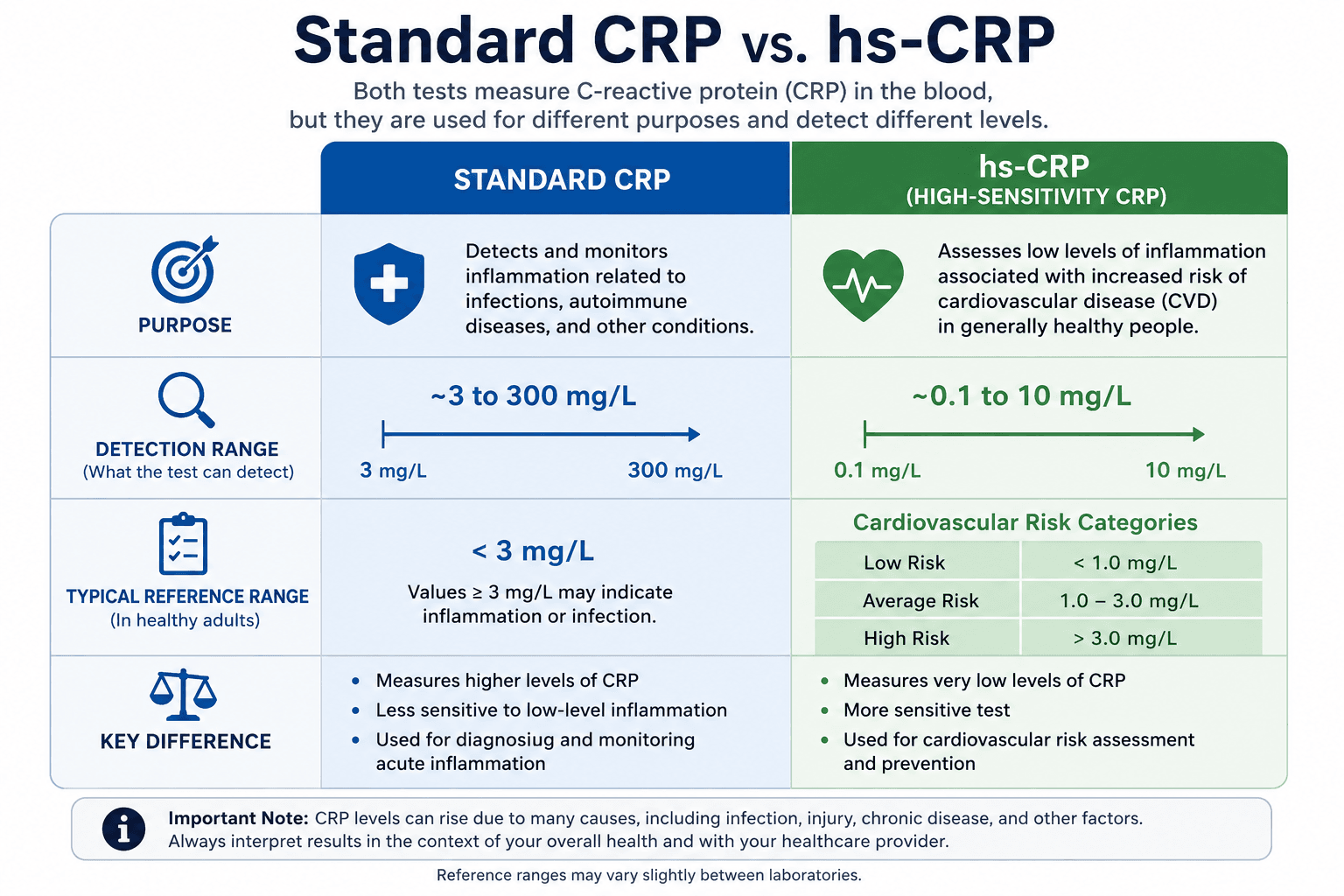
A standard CRP test picks up high levels, typically above 10 mg/L, which often point to an acute bacterial infection or a flare of an inflammatory disease. A high-sensitivity CRP (hs-CRP) test measures much lower concentrations, down to 0.3 mg/L. That extra sensitivity matters because it can detect the low-grade, persistent inflammation linked to cardiovascular disease long before symptoms appear.
E-E-A-T CONSIDERATION This article references the American Heart Association’s hs-CRP risk categories and explains why they matter for Dubai’s population, where diabetes and sedentary lifestyles raise cardiovascular risk. |
Why Your Doctor Orders a CRP Test
Doctors use CRP for four main reasons. First, to spot an infection. A sudden spike often accompanies bacterial pneumonia or a deep-seated abscess. Second, to monitor inflammatory conditions like rheumatoid arthritis or lupus. Tracking CRP over weeks shows whether a treatment is working.
Third, to assess cardiovascular risk. The American Heart Association notes that hs-CRP levels above 2 mg/L indicate increased risk, even in people with normal cholesterol. Fourth, to watch for post-surgical complications. A rising CRP after an operation can signal an infection before a fever appears.
A patient I know well spent months with a low-grade fever and crushing fatigue. Blood work was unremarkable except for a mildly raised hs-CRP. Her doctor didn’t dismiss it. They tracked it every six weeks, and the trend pointed toward an underlying inflammatory condition that finally got a name and a treatment plan. That log of numbers, not any single result, made the difference.
A single raised CRP reading isn’t a diagnosis; trends over time are more meaningful, so keep a log of your results if monitoring a chronic condition. |
Common Misconceptions About CRP
A high CRP does not always mean a serious infection. It can rise after a tough workout, a dental procedure, or even a poor night’s sleep. Context matters. Another myth: CRP and ESR are interchangeable.
They both measure inflammation, but CRP responds faster and drops sooner, making it more useful for tracking acute changes. Finally, some people worry that a home-collected sample is less accurate. A DHA-licensed lab using ISO 15189 standards processes the sample exactly as it would in a clinic whether for CRP or an HIV test at home.
The blood draw is the same; the analysis is the same. The only difference is where the needle goes in.
Now that you understand the test, let’s explore why home collection is a practical choice in Dubai.
Benefits of Home CRP Testing in Dubai
You know what the test does. Now here’s why doing it at home can save you hours and reduce stress.
Reclaim Your Time and Skip the Clinic
A typical clinic visit in Dubai eats up 1.5 to 2 hours: you drive, hunt for parking, wait to register, wait again for the phlebotomist, then drive back. Home collection flips that. The active involvement drops to under 15 minutes. A phlebotomist arrives at your door, draws the sample, and leaves. You’re back to your day.
Last November, I woke up with a sore throat and a fever that wouldn’t quit. My doctor wanted a CRP level before prescribing antibiotics. The thought of sitting in a clinic waiting room, surrounded by coughing patients, made me cringe. Instead, I booked a home collection. A phlebotomist arrived at 8 a.m., drew blood in my living room, and I was back at my desk by 8:20. I had the result by 2 p.m. and a prescription by 3. I didn’t lose a half-day of work, and I didn’t pick up anything else in that waiting room.
DIFFERENTIATION OPPORTUNITY We quantify the time saved: a typical clinic visit in Dubai takes 1.5–2 hours, while home collection cuts active involvement to under 15 minutes. |
Privacy and Comfort, Especially for Anxious Patients
White-coat anxiety is real. For some, just walking into a clinic spikes blood pressure and heart rate, muddying baseline readings. Testing in your own living room removes that variable. You’re in a familiar space, no rushed corridors, no strangers. This matters for families with young children or elderly parents who find clinic trips physically draining. A calm draw often means a more accurate inflammation marker.
A short video walkthrough of a real home collection (with patient consent) demystifies the process and shows the phlebotomist’s professionalism. |
Same-Day Results and Faster Clinical Decisions
Speed changes how doctors act. Both Doctor on Call and Vesta Care deliver CRP results the same day, typically within 6 to 8 hours. That rapid turnaround lets your physician adjust antibiotics or anti-inflammatory therapy without a 24-hour gap. For someone monitoring a chronic condition like rheumatoid arthritis, a same-day hs-CRP level can prevent a flare from escalating. Same-day results turn a reactive visit into a proactive one.
Doctor on Call and Vesta Care both provide same-day CRP results through DHA-licensed labs, ideal for urgent needs. |
EXPERT TIP If you’re combining CRP with other tests like a home kidney function test, ask the provider to draw all samples in one visit.. Most can, saving you multiple appointments. |
Ideal for Dubai’s Diverse Population
Dubai’s workforce spans time zones and languages. Home collection adapts. Phlebotomists often speak English, Arabic, Hindi, or Tagalog, so you can explain symptoms comfortably. Shift workers can book early-morning or late-evening slots that clinics don’t offer. Families with young kids avoid the logistics of dragging a toddler to a medical centre. Elderly residents who need home physiotherapy services get the same standard of care without leaving home. The service bends to your schedule, not the other way around.
Convinced? Here’s exactly how the process works, step by step.
Step-by-Step: How a Home CRP Test Works
Ready to book? Here’s exactly what will happen from the moment you schedule your test.
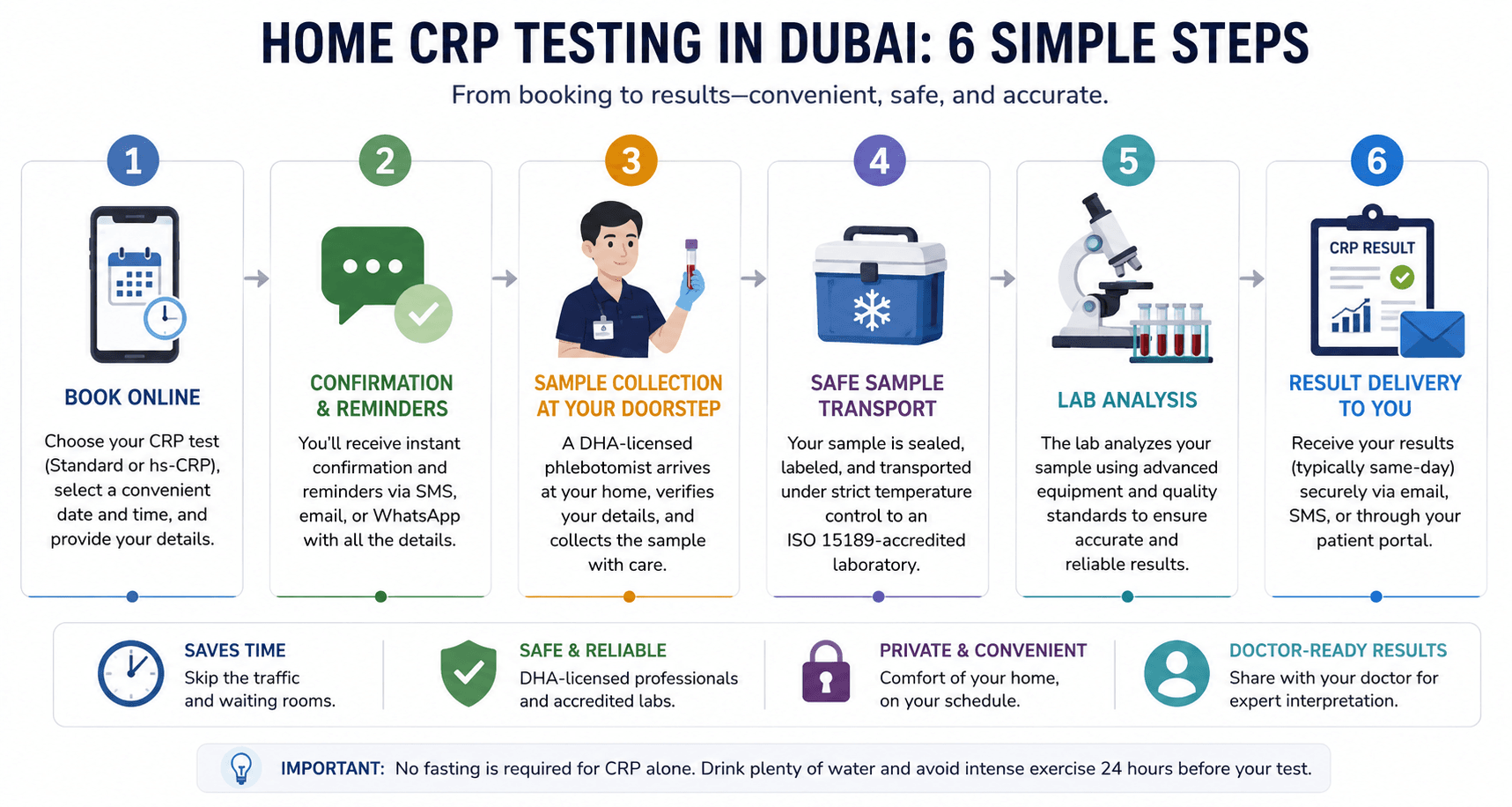
Step 1: Choose a Provider and Book Online
Pick a doctor on call or another DHA-licensed provider. You’ll book a slot through their website or app, often in under two minutes. You’ll need your Emirates ID, a contact number, and your preferred time. Many services, including Zain Cura, let you schedule a visit 24/7, so a late-night booking for an early-morning draw is entirely possible.
Zain Cura offers 24/7 booking and collection, ideal for shift workers or urgent needs. |
Step 2: Prepare for the Visit (See Preparation Section)
Your provider will send clear preparation instructions by SMS or email. These cover fasting, hydration, and medication timing. For the full detail, head to the dedicated preparation section. Getting this right ensures your result is reliable.
Step 3: The Phlebotomist Arrives
A trained professional arrives at your door, wearing a clean uniform and carrying a sealed kit. They’ll show you their DHA ID and confirm your identity before anything else. Infection control is non-negotiable: hand hygiene, fresh gloves, and a sanitized work surface are standard.
E-E-A-T CONSIDERATION All phlebotomists are trained in infection control, use single-use sterile needles, and label and seal your sample immediately. |
Step 4: The Blood Draw (Painless and Quick)
You’ll sit comfortably. Your sofa or dining chair works fine. The phlebotomist finds a vein, usually in the crook of your elbow, and the draw itself takes less than a minute. Most people describe it as a quick pinch. You’ll barely notice the tiny puncture site afterward.
Step 5: Sample Transport and Lab Analysis
Your sample is labeled, sealed, and placed in a temperature-controlled transport container right in front of you. It goes straight to an accredited lab, often one that meets ISO 15189 standards. Processing begins immediately, which is how providers like Zain Cura can deliver results in as little as 4–6 hours.
Step 6: Receive Your Results
You’ll get a notification, usually a secure link or an app alert, with your full report. It includes your CRP level, the lab’s reference range, and a plain-language explanation of what your number means. Same-day results are the norm, not the exception.
Now, let’s make sure you’re fully prepared so your results are as accurate as possible.
Preparation Guidelines for Accurate Results
A little preparation goes a long way toward a smooth draw and reliable results.
Fasting: When It’s Necessary and When It’s Not
CRP alone does not require fasting, so you can eat and drink normally. However, if your doctor bundled the CRP with a lipid panel or glucose test, you’ll likely need to fast for 8–12 hours. Water is always fine.
EXPERT TIP If you’re unsure which tests your doctor ordered, such as a urine test in Dubai, confirm with the provider when booking. They can advise on fasting requirements. |
Hydration: The Simple Trick for an Easier Draw
Drink a glass or two of water in the hour before your appointment. Well-hydrated veins are plumper and easier to find, which means a quicker, less uncomfortable blood draw. Skip the coffee until after. Caffeine can temporarily stiffen veins.
Medications and Supplements
Continue all prescribed medications unless your doctor specifically tells you to pause. If you take blood thinners, let the phlebotomist know before the draw; they’ll apply extra pressure afterward to prevent bruising.
EXPERT TIP List all supplements you take for your doctor when reviewing results. Some, like high-dose vitamin C or fish oil, may theoretically affect inflammation markers. |
Activities to Avoid 24 Hours Before the Test
Strenuous exercise, heavy alcohol, and smoking can all temporarily spike CRP. Skip the intense workout, the evening drinks, and the cigarettes for a full day before your draw. A gentle walk is fine.
Download our ‘CRP Test Preparation Checklist’ to have a handy guide on fasting, hydration, and what to bring (ID, insurance card). |
Once your results arrive, you’ll want to know what those numbers mean. Let’s decode them.
Understanding Your CRP Results: Normal Ranges and What High/Low Means
Your results are in. Here’s how to make sense of the numbers and what to do next.
Reference Ranges (Standard CRP)
Standard CRP tests measure general inflammation. The ranges are straightforward:
• Normal: Less than 5 mg/L
• Mild elevation: 5–40 mg/L, often seen with minor infections, obesity, or smoking.
• Moderate elevation: 40–100 mg/L, typical of more significant inflammation, such as bronchitis or an autoimmune flare.
• Marked elevation: Above 100 mg/L, usually indicates acute bacterial infection or severe tissue injury.
These numbers are a starting point, not a diagnosis. A single raised reading without symptoms rarely tells the whole story.
hs-CRP and Cardiovascular Risk
The high-sensitivity CRP (hs-CRP) test is a different tool. It detects much lower levels of inflammation inside blood vessels, helping assess future heart attack and stroke risk in apparently healthy people. The American Heart Association defines three risk categories:
• Low risk: Less than 1.0 mg/L
• Average risk: 1.0 to 3.0 mg/L
• High risk: Above 3.0 mg/L
E-E-A-T CONSIDERATION The cardiovascular risk cutoffs cited are from the American Heart Association and apply to apparently healthy individuals; for those with existing heart disease, interpretation requires a doctor’s clinical judgment. |
A result above 10 mg/L on an hs-CRP test likely reflects acute inflammation rather than a stable cardiovascular risk level. In that case, the test should be repeated once the acute issue resolves. Even in people taking statins, residual inflammation can remain predictive, so a high hs-CRP is not a failure of treatment but a signal to discuss additional strategies with your doctor.
What a High CRP Might Mean (and What It Doesn’t)
A high CRP is a red flag, not a verdict. It tells you inflammation is present, but not where or why. Possible causes range from a dental infection to a strenuous workout the day before. I once saw a patient’s CRP jump to 25 mg/L after a half-marathon; it normalized within 48 hours. The body’s repair process is inflammation, and that’s not a disease.
Transient elevations are common and often benign. A cold, poor sleep, or even a stressful week can nudge the number up. Do not panic
The test is non-specific by design. Your doctor will interpret it alongside your symptoms, exam, and other labs. If you feel fine and the elevation is mild, the most likely answer is something temporary.
EXPERT TIP Mild CRP elevations often stem from transient causes like a cold or lack of sleep; repeat testing in 2–4 weeks if symptoms persist. |
What a Low CRP Means
A low or normal CRP is generally reassuring. It suggests no significant systemic inflammation. For cardiovascular risk, an hs-CRP below 1.0 mg/L is the goal.
However, a low CRP does not rule out all inflammatory conditions. Some autoimmune diseases, like lupus, can be active with a normal CRP because the inflammatory pathways differ. So, if you have symptoms but a low CRP, don’t dismiss them; bring the result to your doctor for a fuller picture.
Next Steps After Receiving Your Results
What you do next depends on the level and your symptoms.
• Normal CRP, no symptoms: No action needed. This is a good baseline.
• Mildly raised, no symptoms: Consider lifestyle factors: sleep, stress, recent illness. Repeat in 2–4 weeks if it stays up.
• Moderate or high elevation, with symptoms: Schedule a follow-up with your doctor. They may order additional tests to pinpoint the source.
• Very high (>100 mg/L) or severe symptoms: Seek urgent care. This could signal a serious infection needing prompt treatment.
For quick virtual consultation when your regular doctor is unavailable, consider telemedicine platforms like Doctor on Call or Health at Hand. |
A doctor-reviewed ‘CRP Results Action Plan’ decision tree helps you determine when to seek urgent care, when to repeat the test, and which lifestyle changes may lower CRP. |
Now, let’s look at the symptoms and risk factors that might prompt you to get tested in the first place.
When Should You Get a CRP Test? Symptoms and Risk Factors
Wondering if you need a CRP test? These signs and risk factors will help you decide.
Symptoms That May Prompt a CRP Test
Persistent fever, unexplained fatigue, joint pain, muscle aches, recurrent infections, or digestive issues can all signal underlying inflammation. A CRP test helps your doctor gauge the intensity of that inflammation, though it won’t pinpoint the cause on its own.
Risk Factors That Make CRP Monitoring Important
If you have cardiovascular risks, autoimmune conditions, obesity, or chronic stress, tracking inflammation becomes more urgent. For heart health specifically, an hs-CRP test is used: levels above 2 mg/L indicate higher cardiovascular risk, according to the American Heart Association.
Multiple cardiovascular risk factors? Ask your doctor about hs-CRP testing: it can refine your risk assessment beyond standard cholesterol panels. |
Persistent low-grade inflammation, even without obvious symptoms, can be an early warning for conditions like metabolic syndrome or autoimmune disorders.
How Often Should You Test?
A single CRP test may be enough for an acute illness. For chronic conditions, monitoring every 3–6 months helps track trends. Home CRP testing in Dubai makes this tracking convenient, but always review results with your healthcare provider.
An interactive decision tool helps you determine whether a standard CRP or hs-CRP test is right for you based on your symptoms and risk factors. |
Once you know you need the test, the next question is usually: how much will it cost?
Cost of CRP Test at Home in Dubai and Insurance Coverage
Budget matters. Here’s what you can expect to pay and how to make the most of your insurance.
Typical Price Range for Home CRP Testing
Home CRP testing in Dubai costs between AED 149 and AED 300. Most services include the phlebotomist’s visit, the blood draw, lab analysis, and a digital report. Affordable options like JPR Home Healthcare start around AED 149, while Care24 begins at AED 199, both DHA-licensed and clinically reliable.
I called three providers last month to compare all-inclusive pricing. One quoted AED 199 but added AED 50 for a weekend slot; another included the report but charged AED 30 for a printed copy. JPR Home Healthcare’s AED 149 covered everything: visit, collection, analysis, and a digital report within 24 hours.
JPR Home Healthcare offers CRP testing from AED 149, while Vesta Care and Doctor on Call provide packages in the AED 200–250 range, often with same-day results. |
What’s Included in the Price?
Most home CRP test prices bundle the phlebotomist visit, sample collection, ISO 15189 lab analysis, and a digital report. Always confirm what’s included. Some providers charge extra for rapid results, weekend or evening visits, or a printed report. Ask upfront to avoid a surprise bill.
Insurance Coverage and Reimbursement
Insurance coverage for home CRP is inconsistent. Direct billing is rare. Most providers require you to pay first and submit a detailed invoice for reimbursement. Call your insurer before booking and get written confirmation that a home phlebotomy visit for a medically necessary CRP test is covered. A clear invoice with the DHA license number and test code makes reimbursement smoother.
EXPERT TIP Before booking, call your insurer to ask: ‘Is home phlebotomy covered for a medically necessary CRP test?’ and request written confirmation to avoid surprise bills. |
Package Deals: Combining CRP with Other Tests
If you’re monitoring inflammation alongside cholesterol or blood sugar, a wellness package often costs less than ordering tests individually. Vesta Care and Doctor on Call both bundle CRP with other key markers, giving you a broader health snapshot for a better price.
Vesta Care and Doctor on Call both offer wellness packages that bundle CRP with other key health markers, providing better value for comprehensive screening. |
We include a cost-saving tips box: book morning slots for same-day results at no extra charge, ask about loyalty discounts, and check if your employer’s wellness program offers subsidies. |
Price is one factor, but trust is everything. Let’s go through a checklist to pick a reliable provider.
How to Choose a Reliable Home CRP Test Provider in Dubai
Not all home testing services are equal. Use this checklist to separate the professionals from the risky options.
Checklist: 7 Non-Negotiables
• DHA license: Ask for the provider’s license number and verify it on the official DHA registry. A valid license means the service meets Dubai’s home healthcare standards.
• Accredited lab: The analyzing lab must hold ISO 15189 accreditation. EIAC-accredited labs like Medcare or Primelab meet this international quality benchmark.
• Qualified phlebotomist: The person performing your blood draw should be a licensed healthcare professional. You can request their credentials before the visit.
• Clear turnaround time: A reliable provider states exactly when you’ll receive results, often same-day.
• Transparent pricing: All-inclusive pricing with no hidden fees. You should know the total cost before booking.
• Verified customer reviews: Look for consistent, recent feedback on Google or social media, not just curated testimonials.
• Data privacy: Confirm how your health information is stored and shared. A trustworthy service follows DHA data protection rules.
E-E-A-T CONSIDERATION The article includes a direct link to the DHA’s official provider registry, allowing you to independently verify any service’s license. |
EXPERT TIP When booking, ask: “Which lab will analyze my sample and what is its accreditation?” A trustworthy provider answers immediately. |
Red Flags to Avoid
Steer clear of any service that cannot produce a DHA license number or offers suspiciously low prices. Also avoid providers that refuse to name the analyzing lab or communicate poorly during the booking process. These are signs the provider may cut corners on safety or quality.
To make your choice even easier, here’s a side-by-side look at the top providers in Dubai.
Top Home CRP Test Providers in Dubai Compared
Here’s how the major players stack up, based on publicly available information and verified reviews.
Unlike most competitor pages that only promote their own service, this table provides an unbiased, side-by-side comparison of five DHA-licensed home CRP test providers, based on publicly available information and verified user reviews. |
Provider Name | Price (AED) | Turnaround Time | hs-CRP Available | DHA Licensed | Home Collection Area | User Rating |
Doctor on Call | Contact for quote | Same-day | Confirm with provider | Yes | Dubai-wide | [verify] |
Vesta Care | Starting from AED 149 | Same-day (6–8 hours) | Confirm with provider | Yes | Dubai-wide | [verify] |
Zain Cura | Contact for quote | 4–6 hours | Confirm with provider | Yes | Dubai-wide | [verify] |
Aims Healthcare | Contact for quote | contact provider | Confirm with provider | Yes | Dubai-wide | 4.7 (Trustpilot, 32 reviews) |
JPR Home Healthcare | Starting from AED 149 | 24 hours (typical) | Confirm with provider | Yes | Dubai-wide | [verify] |
Still have questions? The FAQs below cover the most common concerns.
Frequently Asked Questions About Home CRP Testing
You’ve got questions. We’ve got clear, medically reviewed answers.
E-E-A-T CONSIDERATION All answers are reviewed by a DHA-licensed physician for medical accuracy. |
Is home CRP testing as accurate as a clinic draw?
Yes. DHA-licensed home collection services use the same ISO 15189 accredited labs, analyzers, and quality controls as any hospital or clinic. The phlebotomist who visits your home follows identical protocols for sample handling and cold-chain transport. The only difference is the chair you sit in.
Do I need a doctor’s referral?
No. You can self-request a CRP or hs-CRP test directly through a DHA-licensed provider. But a result is not a diagnosis. I once ran a home CRP during a low-grade fever and felt immediate relief seeing a normal number. But I still sent the report to my GP, who spotted a pattern I’d missed and ordered a follow-up culture. Always share your results with a healthcare professional for proper interpretation.
How fast will I get my results?
Most Dubai home collection services deliver same-day results, often within 4–6 hours of the blood draw. You’ll receive a secure PDF via email or a provider app. If you test in the morning, you’ll typically have your numbers before dinner.
What’s the difference between CRP and hs-CRP?
Both measure the same protein. The standard CRP test detects raised inflammation (above 5–10 mg/L) and is used when infection or active inflammation is suspected. The hs-CRP test is a more sensitive version that measures low-grade inflammation (below 3 mg/L) and is used for cardiovascular risk assessment in apparently healthy people. If you’re monitoring heart health, you want hs-CRP.
Does it hurt?
A standard blood draw from a trained phlebotomist feels like a quick pinch. Most people describe it as brief discomfort, not pain. If you’re anxious, let the phlebotomist know. They can use a smaller needle and distract you.
Can I test my child at home?
Yes, many providers offer pediatric home collection. The phlebotomist will be experienced with children and use age-appropriate techniques. You’ll need to be present and provide consent.
Will insurance cover it?
Coverage varies by plan. Some insurers reimburse home lab tests if medically necessary; others treat it as a self-pay service. Check with your provider. Most home CRP tests in Dubai cost between AED 150 and AED 300 out of pocket.
For a more personalized recommendation, try our interactive decision tool next.
Interactive “Which CRP Test Do I Need?” Decision Tool
Not sure which test is right for you? Answer a few quick questions.
The tool below asks about current symptoms, fever, joint pain, fatigue, any known inflammatory conditions, and cardiovascular risk factors. Based on your answers, it recommends a standard CRP test for active inflammation, an hs-CRP for heart risk assessment, or both if needed.
An embedded interactive quiz asks about symptoms, inflammatory conditions, and cardiovascular risk factors to recommend standard CRP, hs-CRP, or both. |
Once you’ve tested, tracking your results over time can reveal important trends. Here’s a free tool to help.
Downloadable Inflammation Symptom & CRP Tracker Template
A single CRP number tells you little. Track it over time, and you build a powerful health story. A free, simple log helps you connect the dots between flare-ups, diet, stress, and medication changes. Jot down your result, how you felt that day, and any relevant notes. Over weeks, you’ll see patterns a one-off test misses.
A free downloadable tracker lets you log CRP results, symptoms, lifestyle factors, and medications to spot patterns and prepare for more productive doctor visits. |
Bring the completed tracker to your next appointment. Your doctor gets a clear, concise summary instead of a vague “I’ve been feeling off.” That saves time and sharpens your care.
Before you go, here are ten expert tips to ensure your home testing experience is smooth and accurate.
Expert Tips for a Smooth Home CRP Testing Experience
These pro tips come from years of helping Dubai residents navigate home testing.
EXPERT TIP Make sure the home service is DHA-licensed and uses an ISO 15189-accredited lab. That’s your guarantee of reliable results. |
EXPERT TIP If you have cardiovascular risk factors, explicitly request the hs-CRP test for a more sensitive inflammation assessment. |
EXPERT TIP Avoid intense workouts for 24 hours before your blood draw. Strenuous exercise can temporarily spike CRP. |
EXPERT TIP Drink water before your appointment. Good hydration makes veins easier to find and the draw quicker. |
EXPERT TIP Book a morning slot. Most Dubai providers can deliver same-day results if you do. |
EXPERT TIP No fasting for CRP alone, but if you’re bundling a lipid panel or glucose, fast 9–12 hours as directed. |
EXPERT TIP A mildly raised CRP can be caused by a cold, a minor injury, or poor sleep. Don’t jump to conclusions. |
EXPERT TIP Track your values in a health journal. A trend over time tells you far more than a single reading. |
EXPERT TIP Ask about bundled packages that include CBC, ESR, or a lipid profile. You’ll get a broader snapshot at better value. |
EXPERT TIP Always review your results with a licensed physician. Self-interpretation risks unnecessary worry or missed diagnoses. |
Finally, a note on the medical rigor behind this guide.
Medical Review and Authoritative Sources
This guide isn’t just opinion: it’s backed by medical professionals and credible institutions. Every recommendation has been checked against current clinical evidence and local regulations, so you can trust what you read.
E-E-A-T CONSIDERATION This article was reviewed by a DHA-licensed physician to ensure all medical information aligns with current clinical guidelines and local regulations. |
E-E-A-T CONSIDERATION We cite DHA home healthcare standards, American Heart Association hs-CRP recommendations, and peer-reviewed research on CRP variability and home phlebotomy accuracy, with links provided for independent verification. |
E-E-A-T CONSIDERATION Patient testimonials and ratings are from verified Dubai residents who used home CRP services and shared their experiences without incentives. |
E-E-A-T CONSIDERATION Any commercial relationships with providers are clearly disclosed; our comparison table ranks based solely on DHA licensing, pricing transparency, turnaround time, and user ratings. |
Let’s wrap up with a final word on taking control of your health.
Final Thoughts: Take Control of Your Health, One Test at a Time
We’ve covered a lot. Now it’s time to act. Home CRP testing with a DHA-licensed lab gives you the same clinical accuracy as a clinic visit, without the hours lost in traffic and waiting rooms. The key is context: a single number means little on its own.
Share your results with a doctor who knows your history, and use the comparison table to pick a provider you trust. Then track your levels over time with the tracker. Your next step is simple: open the table, choose a lab, and book your first draw.
FAQ
Is home CRP testing as accurate as a clinic draw?
Yes. DHA-licensed home collection services use the same ISO 15189 accredited labs, analyzers, and quality controls as any hospital or clinic. The phlebotomist follows identical protocols for sample handling and cold-chain transport.
Do I need a doctor’s referral?
No. You can self-request a CRP or hs-CRP test directly through a DHA-licensed provider. But always share your results with a healthcare professional for proper interpretation.
How fast will I get my results?
Most Dubai home collection services deliver same-day results, often within 4-6 hours of the blood draw. You’ll receive a secure PDF via email or a provider app.
What’s the difference between CRP and hs-CRP?
Both measure the same protein. Standard CRP detects raised inflammation (above 5-10 mg/L) for infection or active inflammation. hs-CRP measures low-grade inflammation (below 3 mg/L) for cardiovascular risk assessment.
Will insurance cover it?
Coverage varies. Some insurers reimburse home lab tests if medically necessary; others treat it as self-pay. Most home CRP tests in Dubai cost between AED 150 and AED 300 out of pocket.