You’re not alone in dreading that clinic visit. The thought of sitting in a waiting room, filling out forms, and wondering who might see your name is enough to make anyone put off testing. The clinic receptionist said my name aloud when calling me in, and I decided right there that the AED 399 at-home panel was the only way I’d test again.
That fear is real, and it’s not just about embarrassment. In Dubai, sexual health carries a particular weight. You might worry about your employer finding out, or about a test result appearing on a visa medical record.
You might be confused about when to test after a possible exposure, because the window period, the time between exposure and when a test can reliably detect an infection, varies by infection. Hidden costs add another layer of uncertainty, since a full panel’s price isn’t always clear up front.
DHA-licensed at-home testing changes that. A certified nurse from a home nursing service comes to your home, hotel, or office, collects samples privately, and your results stay protected under UAE medical privacy law.
You skip the waiting room, the clipboard with your name on it, and the awkward phone call to book an appointment.
This guide gives you the complete picture: verified window periods for each infection, transparent side-by-side pricing, and a clear post-result pathway so you know exactly what happens if a result comes back positive.
Confidentiality is the law here. Your results are not shared with employers, immigration authorities, or anyone else without your written consent. Now let’s define exactly what this service is and confirm it’s legal.
The introduction promised a private, legal alternative to clinic visits. This section defines exactly what that service is, confirms its legal standing, and helps you decide whether it fits your situation.
At-home STD testing in Dubai means a DHA-licensed provider sends a certified nurse to your location, whether that is your apartment, hotel room, or office, to collect blood, urine, or swab samples.. This service uses professional collection rather than a DIY self-test kit you order online and interpret yourself. A trained professional handles the collection, and your samples go to a licensed laboratory for analysis.
The flow is straightforward. You book online or by phone, choose your panel, and schedule a collection time. The nurse arrives, collects the sample in about fifteen minutes, and leaves.
Results arrive by SMS, email, or a secure portal, often the same day or within a few hours depending on the provider and panel, and similar rapid turnaround is available for at-home PCR testing.
Some services, like ZenDXB, include free video consultations with a DHA-approved doctor before and after testing, so you can discuss symptoms, risk factors, and treatment without a second appointment.
We have watched enough people freeze at the booking screen to recognize the tell; the ones who actually follow through ask about the nurse’s credentials before price. That question, “Is the nurse DHA-licensed?”, separates a serious patient from someone still deciding. It is the same instinct that makes a good clinician check the license number on the wall before a consultation. When a provider lists “DHA-licensed nurse collection” first in the service description, that is the diagnostic sign the service is legitimate, not a marketing flourish.
At-home STD testing through DHA-licensed providers is fully legal in Dubai. The Dubai Health Authority regulates all licensed health facilities and professionals in the emirate, and that regulatory umbrella covers home collection services operated by licensed clinics. The legality attaches to the provider, not to you as the patient. You are not doing anything legally questionable by requesting a private test at your location.
An independent 2026 guide confirms this plainly. DHA-licensed at-home STD testing is legal, with panels starting from AED 399 and same-day or 4-hour rapid results available. Confidentiality protections under UAE law apply to these services the same way they apply to a clinic visit. The nurse who collects your sample is bound by the same professional obligations as any clinician in a hospital.
The service suits several situations. Sexually active individuals who want routine screening without scheduling a clinic appointment benefit from the convenience. Anyone with a possible exposure who needs answers quickly, and privately, is a natural fit, and the same home collection model works for a tuberculosis test.
Expats concerned about visa or employment implications can test without involving a workplace insurance claim. Tourists who need screening during a short stay avoid navigating an unfamiliar healthcare system. And anyone facing cultural or language barriers gets a controlled, private interaction with a professional who explains each step clearly.
With legality established, the next section explains the specific legal protections that keep your results private.
Building on the legality confirmation, this section details the specific legal protections and how to verify them. The short version: a DHA-licensed provider is legally bound to keep your results private, and you can check that license yourself in a few minutes.
DHA licensing is not a rubber stamp. It covers the entire chain: clinical practice, sample handling, lab processing, and data protection. Only licensed facilities are bound by UAE confidentiality law. An unlicensed operator has no legal obligation to protect your information. The lab that processes your sample matters as much as the nurse who collects it, because a licensed collection service paired with an unaccredited lab still leaves your data exposed.
The biggest trust concern is simple: will my employer or immigration authority see this? No. UAE medical privacy law prevents sharing results with employers, immigration, or any third party without your written consent. These protections are enforced through DHA regulations, not just good intentions. A licensed provider that breaches confidentiality faces regulatory action, so they treat privacy as non-negotiable.
You might wonder whether the lab that processes your sample is actually held to the same confidentiality rules as the clinic that collected it. When I helped a friend verify a provider, I noticed something the marketing never mentions: the DHA license number on the provider’s website links to a registry entry that explicitly lists “patient confidentiality and data protection” as part of the facility’s obligations.
That single line, buried in the official record, is the real differentiator. It means the lab partner is legally bound to the same privacy standards, not just the collection service. I now tell everyone to check that registry entry, because it’s the quiet proof that the whole chain is covered.
Verification takes a few minutes and removes all doubt. Follow these steps:
Now that privacy is established, let’s look at what infections these panels actually screen for.
With privacy protections understood, the next question is which infections a panel actually screens for.
Every at-home panel should include four infections: HIV, the virus that attacks the immune system; syphilis, a bacterial infection that progresses in stages; gonorrhea, a bacterial infection often without symptoms; and chlamydia, the most common bacterial STI.
Gonorrhea and chlamydia are tested together with NAAT, a highly accurate molecular test, using a urine sample or swab. AED 399 for a 7-pathogen panel sounded like a full screen, but the list was mycoplasma hominis, ureaplasma parvum, and trichomonas, not HIV or syphilis, so I had to add those separately.
Extended panels add hepatitis B and C, viruses that infect the liver and can be passed through sex; herpes HSV-1 and HSV-2, which cause oral and genital sores; and trichomonas, a common parasite. Ordering a comprehensive panel is more cost-effective than testing for each infection separately, and similar home collection panels can assess hormone balance.
A basic panel covering the core four is enough for routine screening when you have no specific exposure. If you had a possible exposure or want peace of mind, a comprehensive panel is worth the extra cost. Vesta Care’s STD 7A covers 7 common STIs, while Aster at Home and ZenDXB offer 14-pathogen panels for broader coverage.
Knowing what to test for is only half the equation. Knowing when to test is equally critical.
Knowing what to test for leads directly to the question of when to test, and getting this wrong is the most common mistake.
A window period is the time between possible exposure and when a test can reliably detect an infection. Test too early and you risk a false negative: the infection is there, but your body hasn’t produced enough of what the test looks for yet.
Understanding timing is straightforward once you know the numbers. Each infection has its own detection clock, and the rules don’t change.
The 4th generation HIV test, the current standard that detects both the virus itself and your immune response, is reliable from 4-6 weeks after exposure (18-45 days). Gonorrhea and chlamydia, tested with NAAT (a highly accurate molecular test), are detectable from 1-2 weeks. Syphilis shows up from about 3 weeks.
Hepatitis B has the longest window at 8-22 weeks. Hepatitis C ranges from 2-26 weeks. Herpes HSV seroconversion takes 3-6 weeks, though detection can occur as early as 2-21 days.
The guidelines said gonorrhea and chlamydia NAAT tests are reliable from 1-2 weeks. A client’s test came back positive days before the official window opened. The lab confirmed it. That early detection didn’t change the rule; it just reminded me that window periods mark when you can trust a negative, not when a test first becomes capable of finding something.
A negative result before the window period is not conclusive. The infection may simply not be detectable yet.
The rule of thumb: wait until the longest relevant window period, 6 weeks for HIV, before considering results definitive. If you tested earlier and got a negative, schedule a repeat test at the right time.
With timing understood, let’s walk through exactly what happens when you book a test.
With timing clear, you now know when to test. The next question is what actually happens when you book an at-home STD test in Dubai. The process is simpler than most people expect, and every step is designed to keep your information private.
You start by choosing a DHA-licensed provider and the panel that matches your exposure. Vesta Care’s STD 7A panel, for example, screens seven common infections from a single urine sample for AED 399, with same-day home collection available. ZenDXB’s 14-panel option includes two free video consultations with a DHA-licensed doctor and private courier collection.
Booking is done online or by phone. You provide your location, confirm the total price before committing, and receive a confirmation with your appointment window. Same-day appointments are common, which matters if you want answers quickly.
Last November, while helping a client in Dubai Marina arrange testing after a condom break, I watched the booking screen show a same-day collection slot. The detail that clicked for me was the 48-hour result turnaround on Vesta Care’s STD 7A panel.
That number meant the client could go from panic to a clear answer within two days, without a single clinic visit. I’ve since recommended that specific panel to anyone who needs fast, private screening, because the logistics are as important as the test itself.
On the day, a nurse or courier arrives with sterile, sealed collection materials. The whole process takes minutes. The sample type depends on your panel: blood for HIV, syphilis, hepatitis, and herpes; urine for gonorrhea and chlamydia; and swabs for specific infections like trichomoniasis or mycoplasma.
Aster at Home kits, for instance, may include a finger-prick blood sample, urine, or a vaginal swab depending on what you order. You never have to leave your home, and the collector is trained to handle everything professionally and privately. 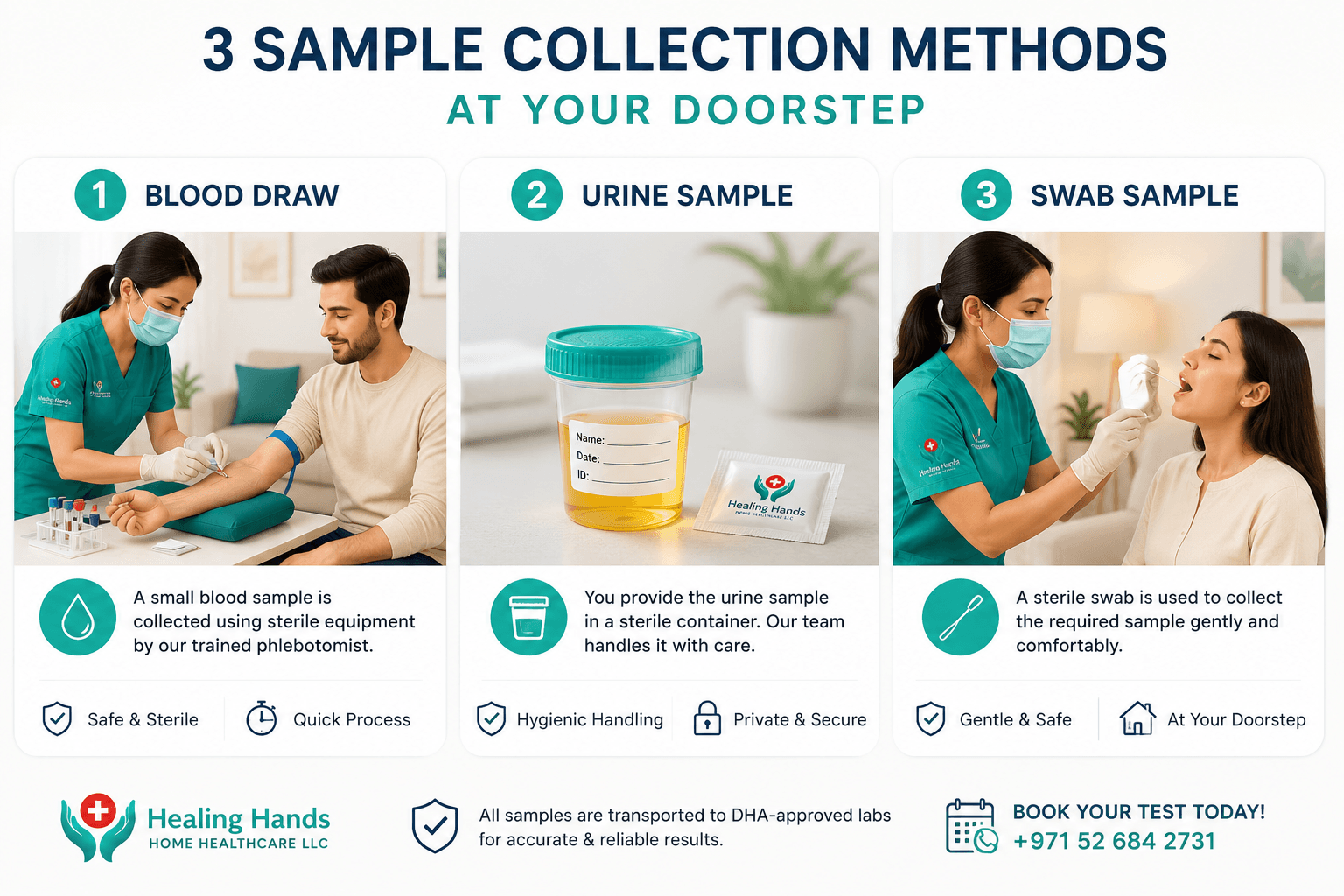
Your sample goes to a DHA-licensed laboratory, the same type of facility that processes clinic samples, and many providers also offer general lab tests at home for other health checks. Turnaround times vary: Vesta Care reports results in 48 hours, while other providers may take up to five days.
Results are delivered only to you, through an encrypted portal, a direct phone call, or a secure app like WhatsApp. Never accept results over unencrypted email. ZenDXB sends results straight to your mobile and includes two free video consultations with a DHA-licensed doctor, so you can discuss what the results mean without another appointment.
Now let’s address the question every reader is asking: how much does this cost?
After understanding the process, the next question is always: what will this cost me?
Most provider pages bury pricing behind consultation requests. This table puts verified AED figures side by side.
| Provider | Individual Test Price (AED) | Panel Price (AED) | Infections Screened | Result Turnaround | Doctor Consultation Included |
|---|---|---|---|---|---|
| Vesta Care | From 199 | 399 (STD 7A) | 7 | 48 hours | Not specified |
| Skin111 | From 270 | Varies by profile | Varies by profile | Same-day blood | Free consultation |
| Health Call | Not published | 770 (STD Panel 7) | 7 | Not specified | Free |
| Aster at Home | Not published | 1,100 (14 pathogens) | 14 | Not specified | Not specified |
| ZenDXB | Not published | From 399 | 14 | 24-48 hours | Two free video consultations |
A headline price typically covers the collection visit, lab processing, and result delivery. Doctor consultation is where costs diverge. Some providers bundle it free; others charge separately. Confirm the total upfront before booking.
Pay upfront, or spread costs with Tabby Pay or 0% interest plans from Skin111 and Aster at Home. Bundle panels instead of ordering individual tests. Comparing two quotes side by side, the 14-pathogen panel looked impressive until we realized the 7-panel at AED 399 covered everything we actually needed, and the free consultation mattered more than the extra pathogens. Compare total costs, not just headline prices.
With costs clear, readers need to decide which testing method is right for their situation.
With pricing understood, the next decision is which testing method fits your situation best. The three options differ in accuracy, cost, speed, privacy, and how DHA regulation applies to each.
At-home professional collection matches clinic accuracy because the same DHA-licensed laboratories process both sample types. A nurse collects your blood, urine, or swab correctly, then the sample goes to the same lab that would handle a clinic visit. The only difference is where the collection happens.
DIY self-test kits carry a higher risk of collection errors. You swab yourself, often without training, and a poor sample can produce an inconclusive result. That means a retest, more waiting, and more anxiety. Collection method matters as much as lab processing.
Cost is the one area where DIY kits win on paper. They are cheaper upfront, but an inconclusive result forces a repeat purchase and another wait. At-home professional testing costs more than DIY but less than a clinic visit when you factor in time off work and transport.
Speed is comparable between at-home and clinic testing. Both offer same-day or 4-hour rapid results from DHA-licensed labs. DIY kits add mailing days, and you still wait for the lab to process the sample after it arrives.
Privacy is highest with at-home testing. No waiting room, no registration desk, no one sees you walk into a sexual health clinic. UAE law protects the confidentiality of your results, and at-home collection keeps the entire process private.
DHA regulation applies to at-home and clinic testing. Both use licensed professionals and licensed labs. Many DIY kits sold online fall outside DHA oversight, which means no guarantee of lab quality or result accuracy.
Choose at-home testing when you want privacy, professional collection, and fast results without leaving your home. It is the best balance for most Dubai residents.
Choose a clinic if you need an in-person consultation, have complex symptoms, or want a doctor to examine you. The trade-off is less privacy and more time.
Choose a DIY kit only if you have no access to a DHA-licensed at-home provider. The lower accuracy and lack of regulatory oversight make it a last resort.
I’ve watched too many people fumble a DIY swab and then panic over an inconclusive line. The at-home professional collection is the only option I’d recommend to a friend in Dubai, and the reason is simple: the same DHA-licensed lab that would process a clinic sample processes yours, but you never sit in a waiting room. A nurse comes to you, collects the sample correctly, and you get same-day results. That’s the difference between a test you can trust and a test you have to second-guess.
Once you’ve chosen at-home testing, here’s exactly what happens during the collection visit.
After choosing at-home testing, you probably want to know exactly what happens during the visit. The process is straightforward. Knowing the steps ahead of time removes most of the anxiety.
The nurse cleans the area, uses a sterile single-use needle, draws a small vial of blood, and applies a bandage; the same home collection model is used for thyroid testing at home. The whole thing is quick. This sample tests for HIV, syphilis, hepatitis B and C, and herpes, and the same home blood draw model can be used for a CBC test at home. Nurses are trained to keep it as comfortable as possible.
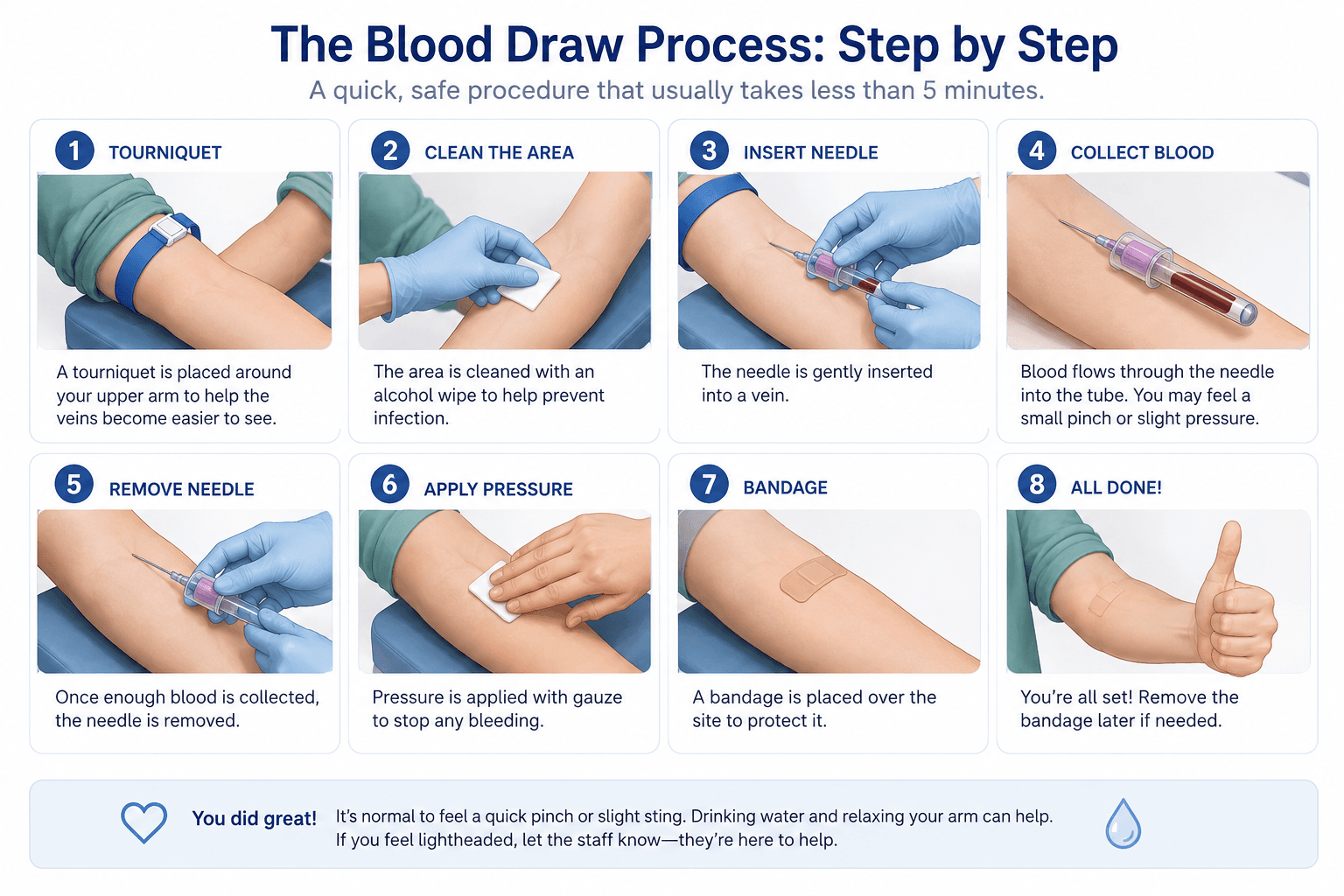
You collect urine privately in a sterile container for urine testing.
This sample is used for gonorrhea and chlamydia NAAT testing, a highly accurate molecular test. I used Vesta Care’s home collection for their 7-panel test, and the urine sample part was simpler than I expected: a private moment with a sterile cup, no awkward clinic bathroom.
The nurse waited outside, and the whole thing was over quickly. Swabs may be throat, genital, or rectal depending on what’s being screened. Comfort and privacy are always prioritized.
Preparation is minimal. Confirm your appointment, have your Emirates ID ready, and avoid urinating for one hour before if instructed. Stay hydrated for the blood draw, and write down any questions you want to ask. No special prep is typically required.
Once your samples are collected, the next step is understanding what your results mean.
After the collection visit, the waiting begins, and then the results arrive. Here’s what each outcome means.
A negative result means no infection was detected. That is the headline, and for most people it is the end of the story.
The caveat matters. A negative result is only reliable if the test was taken after the full window period, the time between possible exposure and when a test can reliably detect an infection. Test too early and the infection may not have produced enough of a marker for the test to find. If you tested before that window closed, schedule a repeat test at the right time. A negative result with correct timing means no further action is needed.
A positive result is not a crisis. It is a medical finding with a clear path forward, and most STIs are either curable or manageable.
The emotional reality comes first. Seeing a positive result on your phone, alone, can feel overwhelming. That reaction is normal, and it does not mean you made a bad decision or that your life has changed permanently. It means you now have information you can act on.
The treatment outlook is better than most people expect. Chlamydia, gonorrhea, and syphilis are fully curable with antibiotics. HIV is manageable with antiretroviral therapy, or ART, which keeps the virus suppressed and allows a normal life expectancy. Herpes is manageable with antivirals that reduce outbreaks and transmission. Hepatitis C is curable in most cases with modern medication.
A DHA-licensed doctor on call interprets your result and prescribes the right treatment. With providers like ZenDXB, that consultation happens by video, and the medication is delivered to your door. You never have to walk into a clinic or explain yourself to a pharmacist.
An inconclusive result is not a positive result. It means the sample could not be clearly read, often because of sample quality or because the test was taken too early in the window period.
The provider handles this for you. They arrange a repeat collection at no extra cost or recommend a confirmatory test. You do not pay again, and you do not have to figure out the next step alone. An inconclusive result is a technical hiccup, not a diagnosis.
If your result is positive, current and recent partners should be informed and tested. This is not about blame. It is about stopping the infection from moving back and forth between you.
Partner testing avoids reinfection. If you are treated but your partner is not, you can be reinfected within weeks. Providers can arrange partner testing confidentially, so your partner gets the same private, straightforward process you did.
Keep a personal record of your results and test dates. Store them securely, because you may need them for follow-up care or future reference. A password-protected note or a locked folder is enough.
AED 130 is the entry price for a basic panel, and that figure stuck with me because it is less than a dinner for two in Dubai Marina, yet it buys the certainty that either ends the worry or starts the treatment.
Knowing what happens after results, readers need a practical framework for choosing the right provider.
With post-result pathways understood, you need a practical framework for choosing the right provider. The difference between a good experience and a bad one comes down to a handful of verifiable details.
Work through these eight points before you book:
I expected the hard part to be finding a provider that would actually show up at my door. The hard part turned out to be finding one that would tell me who was testing my sample. Two providers quoted me similar prices for similar panels, but only one listed a named doctor with a DHA licence number right on the page. That transparency decided it for me, and the results arrived when they said they would.
Some warning signs are immediate dealbreakers:
This guide doesn’t rank providers by sponsorship or advertising. Each one was assessed against the same five criteria:
To make all of this concrete, here’s what a real testing journey looks like from start to finish.
To make everything concrete, here’s what the full journey looks like through one person’s experience.
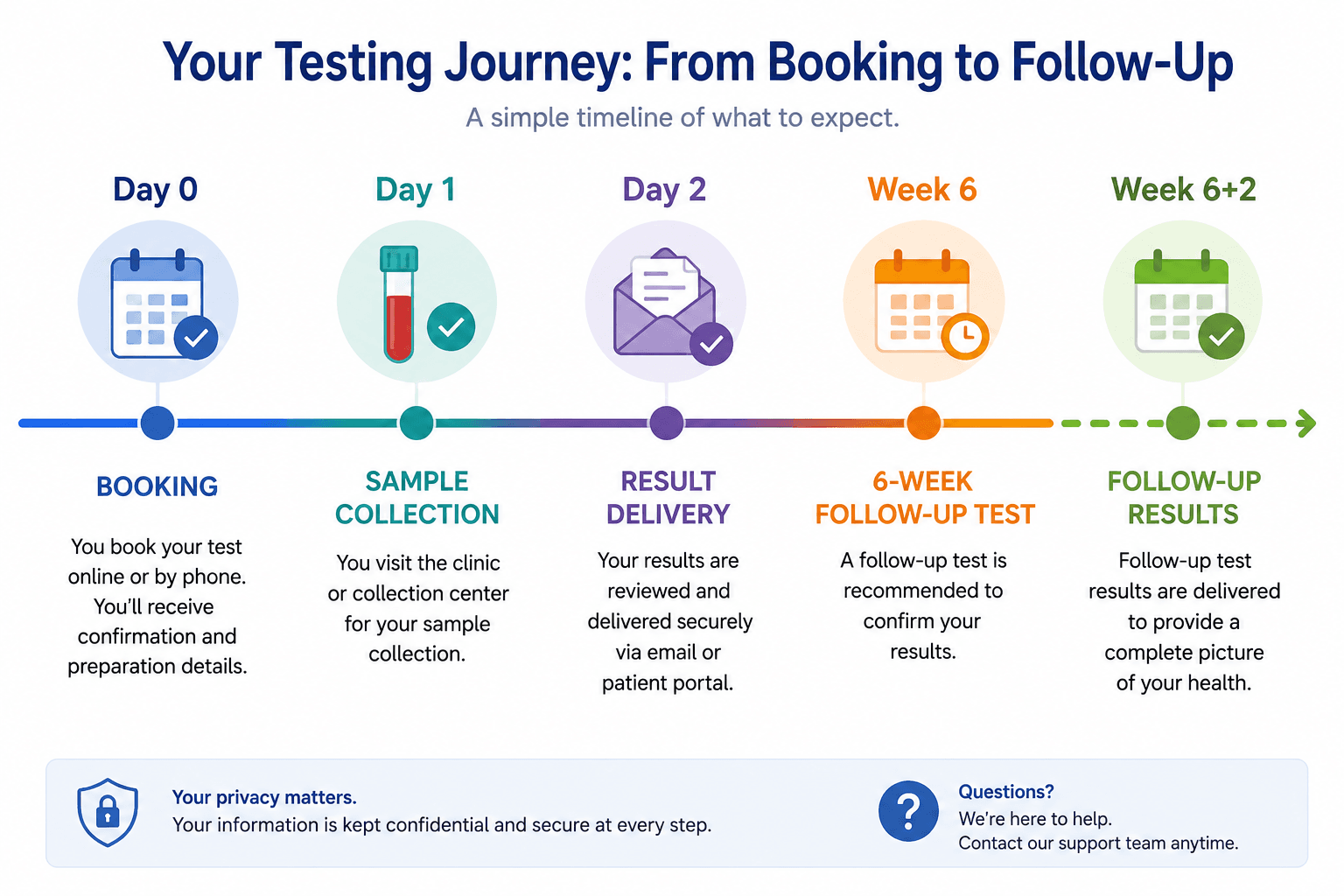
The phone rings at 11pm. A client’s partner just tested positive, and the panic in her voice is real. We walk her through the window periods: HIV needs 4-6 weeks, gonorrhea and chlamydia 1-2 weeks, syphilis about 3 weeks. She books a comprehensive panel for the next morning. The nurse collects samples in about 10 minutes, and results land in her encrypted portal the next day. That first negative result doesn’t end the story, but it starts the shift from fear to a plan. By the time she gets the final negative at Week 6+2 and a free doctor consultation, the anxiety is gone. Understanding that follow-up testing is normal, not a failure, is what makes the whole process bearable.
Day 0: Sara’s partner calls with news of a positive test. She feels the floor drop. She searches online at midnight, finds this guide, and reads about window periods for the first time.
Day 1: She books a comprehensive panel through a DHA-licensed provider. A nurse arrives at her apartment, collects samples in about 10 minutes, and leaves. No clinic, no waiting room.
Day 2: Results appear in her encrypted portal. Negative for everything, but the HIV window period hasn’t elapsed yet. The report clearly states a follow-up test is needed at Week 6.
Week 6: Sara takes the follow-up HIV test, a 4th generation antigen/antibody test that detects both the virus and her immune response. Same 10-minute collection, same next-day portal.
Week 6+2: The final result is negative. Sara books the free doctor consultation included with her panel. A physician reviews her results, answers her questions, and confirms she’s clear. The anxiety that started at Day 0 is gone.
Window periods matter. A negative result before the window closes is not a final answer. Follow-up testing is a normal, expected part of accurate screening, not a sign something went wrong.
The process is fast and private. Sample collection takes about 10 minutes, and results arrive via encrypted portal the next day. You skip the awkward phone calls and clinic visits.
The free doctor consultation after a final negative result is a concrete value-add. It turns a lab report into a conversation, and that conversation reduces anxiety more than any number on a screen.
This journey is typical. It’s designed to move you from concern to clarity in a matter of weeks, with each step clearly marked.
If you’re still unsure which test is right for you, this decision guide will help.
Still unsure which test you need? This decision guide matches your situation to the right panel.
If you have symptoms like discharge, burning, sores, or unusual pain, do not wait. Book a comprehensive panel with professional sample collection, ideally same-day or next-day. A clinician-collected swab or blood draw reduces the chance of a botched self-sample when you are already uncomfortable.
During the included consultation, describe every symptom plainly. The doctor can adjust which infections get priority testing and may start treatment sooner. ZenDXB’s 14-panel test includes two free video consultations with a DHA-approved doctor, exactly the support you want when symptoms are active.
No symptoms? Your choice depends on partner count and time since your last test. If you have had one partner and tested within the past year, a basic panel covering the core four infections (HIV, syphilis, gonorrhea, chlamydia) is usually enough. If you have had multiple partners or it has been over a year, go comprehensive.
A 14-panel test catches infections that a basic panel misses, like herpes and hepatitis. Skin111 offers individual tests from AED 270 after discount, so you can build a panel that fits your exposure history without paying for tests you do not need.
Test for the specific infection your partner named, and do it as soon as possible. But do not stop there. Co-infections are common, so add a comprehensive panel to rule out anything else.
If your partner tested positive for chlamydia, for example, you want a NAAT (a highly accurate molecular test) for chlamydia and gonorrhea, plus HIV and syphilis screening. Consider testing simultaneously with your partner so you both get results on the same timeline and can start treatment together if needed. ZenDXB’s private courier sample collection makes this easier if you cannot both visit a clinic.
Start with a core four panel covering HIV, syphilis, gonorrhea, and chlamydia. That is the minimum responsible screen. If money is tight, use Tabby Pay to split the cost into installments, and check for promotional discounts.
When I called Skin111 to confirm their same-day blood results, the booking agent told me the HIV Combo at AED 270 includes a free doctor consultation. That changed how I advise clients on budget panels.
Compare total costs across providers. Skin111’s individual tests can be cheaper if you only need one or two. ZenDXB’s 14-panel test with two free video consultations and treatment delivery may cost more upfront but saves you separate consultation fees later.
Before you go, here are the most common questions readers ask.
You now have everything you need to take the first step with confidence. At-home STD testing in Dubai is legal and confidential under UAE law, and DHA-licensed providers deliver accurate, lab-processed results.
Will anyone else find out? When I booked through a DHA-licensed provider, the confirmation email stated clearly that results are protected under UAE law, and the courier who collected my sample asked only for the booking reference, not my name. That small detail made the whole process feel private, not clinical.
The hardest part is the first step. That step is simply booking a test. Choose a DHA-licensed provider, verify their license on the DHA website, and book. Results often arrive the same day or within a few days, so you won’t be left waiting long.
Yes. DHA-licensed at-home STD testing is fully legal. The DHA regulates all licensed facilities, including home collection services.
No. UAE medical privacy law protects patient data. DHA-licensed providers are bound by confidentiality. Nothing is shared without your written consent.
It depends on the infection and its window period, the time between exposure and when a test can reliably detect it. Gonorrhea and chlamydia are detectable from 1 to 2 weeks, syphilis from about 3 weeks, and HIV with a 4th generation test from 4 to 6 weeks. Testing too early can produce a false negative.
No. Professional collection by a certified nurse reduces sample errors and inconclusive results. DIY kits are more prone to collection mistakes.
Most common STIs are curable or manageable. A doctor consultation interprets your result, prescribes treatment, and arranges medication delivery. Partner testing is recommended.
Ask for the DHA license number and check it on the DHA website licensing section. Only book with providers whose license is active and verifiable. Everything you need is in this guide. Here’s how to take the first step.