
The ad says “from AED 99.” The invoice rarely does. That gap is the whole problem: you see a test fee, then a separate home collection fee appears at checkout or at your door.
The invoice that broke me was a CBC listed at AED 150 with a separate AED 80 collection line beneath it; I stopped comparing headline fees that day and now ask for the all-in price before I book.
This guide is the Honest Price Decoder: a test-by-test reference where every price already includes the collection visit. No surprise add-ons. It is built for Dubai residents and visitors paying out of pocket, because that is who gets caught by the gap.
The price table below is the fastest way to see the real numbers.
Here is the decoder itself. The numbers below separate what most Dubai providers bundle into one vague quote.
The price column is test-only. The collection fee is a separate per-visit charge. Add them for the all-in price. A CBC at AED 100 plus an AED 50 collection fee costs AED 150 all-in.
Most people pick a blood test by the sticker price and ignore the collection fee. I watched a colleague do exactly that last month. She saw a CBC listed at AED 70, booked it, and only at checkout noticed the AED 60 home visit charge. The all-in was AED 130, nearly double the test fee. What mattered was not the test price but the sum of both numbers, and she would have compared differently if the provider had shown that total up front.
| Test Name | Approx. Price (AED) | Home Collection Fee (AED) | Fasting Required? | Result Turnaround |
|---|---|---|---|---|
| CBC (Complete Blood Count) | 50-150 | 50-80 | No | 24-48 hours typical |
| HbA1c (Diabetes) | 60-170 | 50-80 | No | 24-48 hours typical |
| TSH (Thyroid) | 60-180 | 50-80 | No | 24-48 hours typical |
| Vitamin D | 80-220 | 50-80 | No | Often 2-5 days, varies by lab |
| FBS (Fasting Blood Sugar) | 30-80 | 50-80 | Yes | 24-48 hours typical |
| Lipid Profile (Cholesterol) | 80-150 | 50-80 | Yes | 24-48 hours typical |
| LFT (Liver Function Test) | 80-180 | 50-80 | Yes | 24-48 hours typical |
Home collection fee is per visit, not per test. Dr Plus bundles the home visit free within Dubai.
Providers sell packages, and bundling can be cheaper than paying per test. Medilife lists a Standard Blood Test package from AED 250, a Vitamin Profile at AED 350, and a Hormonal Profile at AED 850-875. Dr Plus offers a full body basic package from AED 399 and a cancer hormone test from AED 699.
The advertised ‘from’ price rarely includes the collection visit. The table below shows the gap across six named Dubai providers. Indicative, verify current pricing before booking.
| Provider | Advertised Starting Point | Realistic All-In Cost for Standard CBC | What to Verify |
|---|---|---|---|
| Lab Tests Dubai | AED 50-150 (test-only range) | AED 100-230 (test + AED 50-80 collection) | Exact test fee and whether collection is included |
| Nightingale | AED 99-199 (from pricing, no test-wise table) | Not confirmed, verify (no CBC price published) | Whether the AED 99 includes home collection |
| DCDC | AED 199 collection fee (tests separate) | AED 199 + test fee (not published) | Per-test CBC price |
| Dr Plus | AED 199 (single tests from) | AED 199 (home visit free within Dubai, confirm CBC price) | CBC price and whether it is a single test |
| Medilife | AED 250 (Standard Blood Test package) | AED 250+ (confirm CBC included in package) | Package contents and collection fee |
| Feelvaleo | Under AED 99 (individual tests) | Not confirmed, verify (CBC not listed) | CBC price and collection fee |
Before you book, add the two numbers together. The collection fee is where the surprise lives.
The price table shows two numbers for every test. Here is why.
Every home blood test bill splits into two charges, and the same collection-fee logic applies to a stool test at home. The test fee pays the lab for analyzing your sample. The collection fee pays for the nurse or phlebotomist who comes to your door. In Dubai, that collection fee typically runs AED 50-80 per visit, on top of whatever the test itself costs.
A test that a lab lists at AED 100 is rarely AED 100 all-in. Add the collection visit and you are looking at AED 150-180 before anything else gets factored in.
Wondering why two providers quote different totals for the same test? I’ve watched this pattern repeat across a dozen bookings. The test fee stays in the same band, but the collection charge swings from zero to AED 199. Dr Plus folds the home visit into the test price, so the quote you see is the quote you pay. Doctors Clinic lists the test separately and adds AED 199 for the nurse’s visit. Same vial of blood, same lab analysis, two very different final bills. That gap is the real differentiator, and it is never in the headline price.
A “from AED 99” headline usually points at the cheapest single test on the menu, not the all-in price. Nightingale Dubai advertises prices from AED 99-199 across 200+ tests, but publishes no test-wise price table. The AED 99 figure almost certainly covers the simplest test, before the collection visit is added.
The final bill lands higher. Sometimes much higher. That is the gap between the advertised starting price and what you actually pay.
Free home visits within Dubai are common. Dr Plus includes them. Other providers structure it differently: Doctors Clinic charges AED 199 for collection on top of the test fee, and some clinics add travel charges for certain areas or for other emirates, which can apply to any home draw including a malaria test.
Packages can beat individual tests, but only when the bundle includes the biomarkers you actually need. A full body basic package from Dr Plus starts at AED 399, which looks attractive next to several individual tests. But if the package includes a thyroid panel you do not need and skips the vitamin D you do, you are paying for extras and still booking a second draw.
Bundling wins when the package matches your doctor’s actual request. Otherwise, individual tests with a single collection fee can be cheaper.
Price is only half the safety equation; the next section covers the license that actually protects you.
A cheap price means nothing if the lab is not licensed. Before you compare all-in prices, confirm the provider can legally draw your blood in Dubai.
The Dubai Health Authority licenses healthcare facilities and professionals. A DHA-licensed provider meets Dubai’s regulatory requirements for home blood collection. That license covers two things: the lab processing your sample, and the nurse or phlebotomist who shows up at your door.
One expired license. That was what the Sheryan portal showed me when I checked a provider whose booking page still said “DHA-licensed.” The expiry date sat right there next to the license number. That gap is exactly why you verify before paying.
DHA licensing is the floor. CAP and JCIA accreditation sit above it, and labs choose whether to pursue either. The College of American Pathologists (CAP) Laboratory Accreditation Program is a recognized laboratory quality standard. Joint Commission International (JCI) publishes accreditation standards for laboratories, adding another international quality layer. A lab that holds one of these has invested in quality controls beyond what a basic license requires.
Go to dha.gov.ae and open the Sheryan portal’s “Verify Professional License/Registration Status” service. Enter the provider’s DHA Unique ID or License Number. Then check the facility name and the professional’s name against your booking confirmation, character for character. The search itself takes seconds.
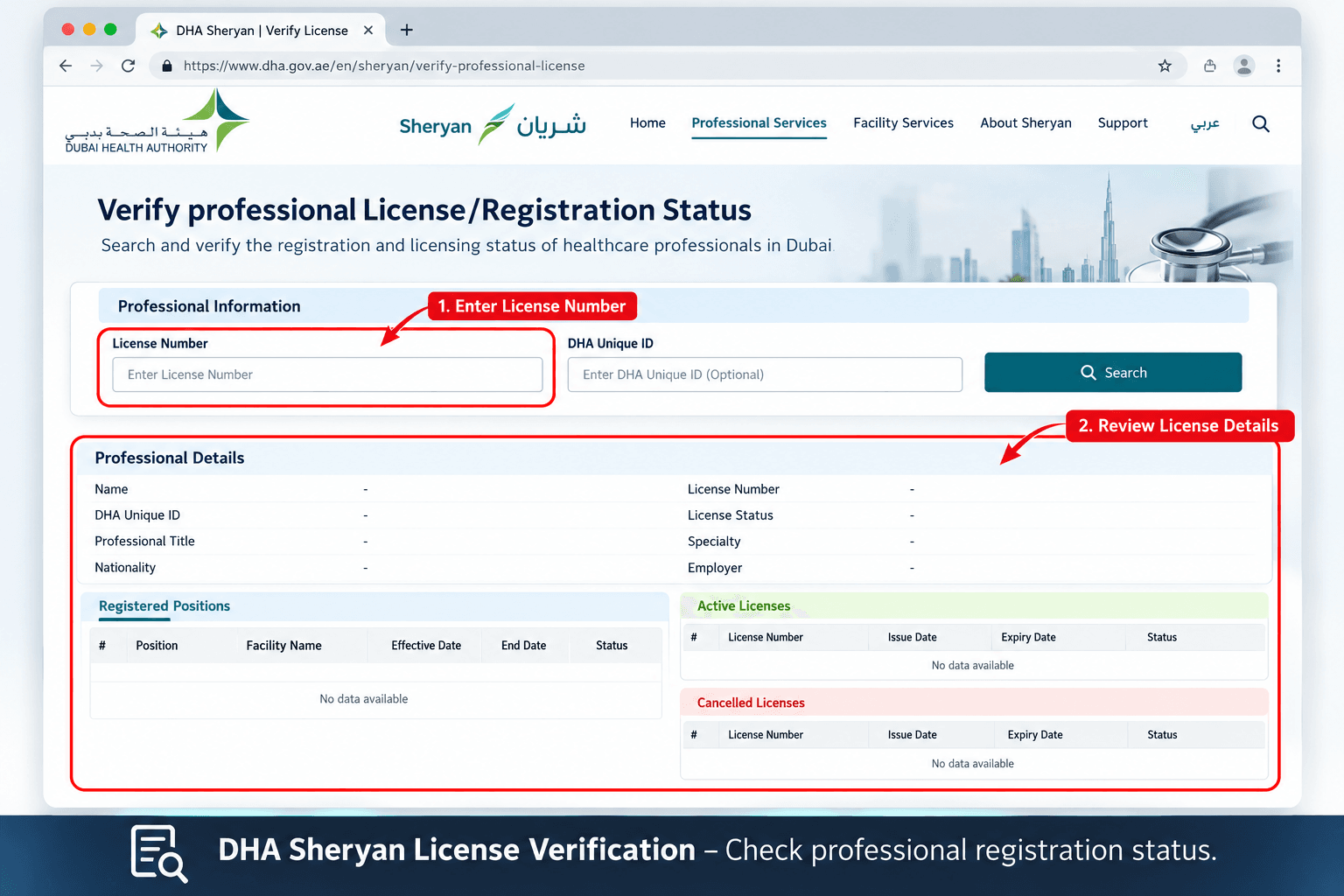
Confirm these four things before you hand over payment details:
License confirmed. Now make sure you fast correctly, because that changes how you schedule the visit.
Fasting is the detail that trips people up, so here is the short version.
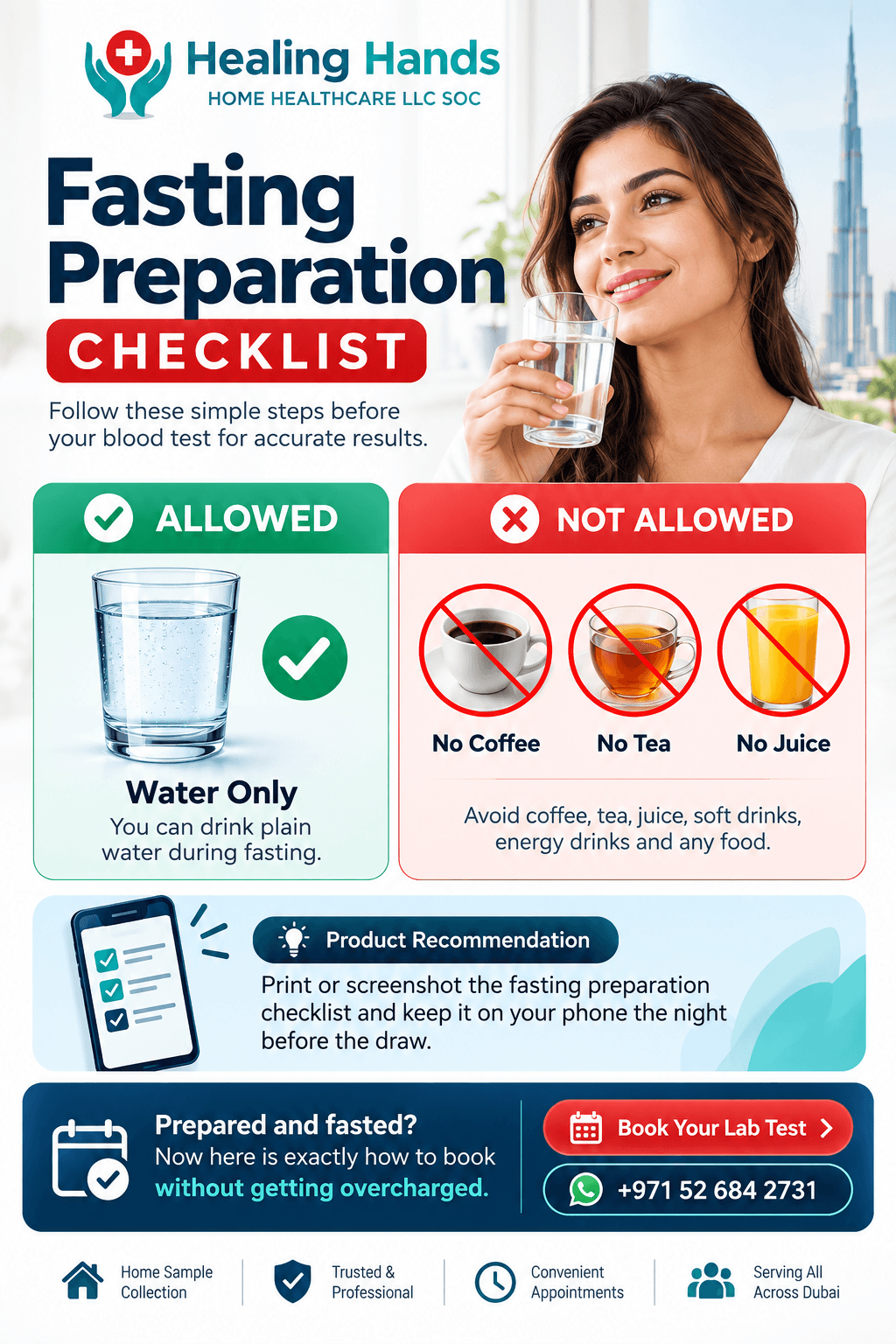
FBS, lipid profile, fasting insulin, and triglycerides all need 8-12 hours without food. Glucose and lipid levels shift after you eat, and a single non-fasting draw can push a normal result into a false red flag, which is why diabetes home testing often starts with an early-morning draw. Plain water is fine. Coffee, tea, and juice are not, because caffeine and sugar both move the numbers even without food.
CBC, HbA1c, TSH, and Vitamin D need no fasting. HbA1c measures a three-month average, so a meal the night before changes nothing. TSH and Vitamin D are hormone and vitamin levels that stay stable regardless of when you last ate.
Providers get this wrong often enough that it is worth double-checking the instructions. The booking form for my Vitamin D test said “fasting required” in bold red. Vitamin D does not need fasting. I skipped breakfast and sat through a 9am draw with a headache.
The nurse looked at the form and said, “You didn’t need to fast for this one.” That sloppy instruction was the tell.
The same provider later quoted AED 220 for the test and only mentioned the AED 80 collection fee when I asked. A provider that gets fasting wrong will blur the all-in price too.
Booking is straightforward. The trick is confirming the all-in price and the license before you commit.
Use the price table to find your test and its all-in cost. The test fee alone isn’t the number that matters. Home collection adds roughly AED 50–80 on top, so a CBC quoted at AED 50 can land at AED 130 all-in.
While helping a neighbor sort out her annual checkup in March, I watched her confirm a lipid panel at AED 80 and assume the nurse visit was bundled. The provider’s booking page listed only the test fee. The phlebotomist’s arrival confirmation mentioned an AED 80 collection charge, the top of the range the FAQs cite as “roughly AED 50-80.” My finding: the range is accurate, but the number is precise and never volunteered. You have to ask.
Use the DHA portal and the safety checklist to shortlist providers. The Sheryan portal’s ‘Verify Professional License/Registration Status’ service lets you check a professional’s status by DHA Unique ID or License Number. Do this before you commit.
Most providers accept phone, WhatsApp, and online booking. WhatsApp is often the fastest way to confirm the price.
Fasting, hydration, and having an Emirates ID or passport ready. The fasting section covers which tests need 8–12 hours without food. Have your ID out and a glass of water nearby.
The nurse or phlebotomist arrives, verifies your identity, draws the sample, labels it, and follows hygiene protocols. The whole visit is quick.
Reports are usually delivered by email, app, or WhatsApp. A GP or telehealth follow-up can help interpret results.
Booked. Next question: pay out of pocket, or run it through insurance?
Most routine tests can be self-booked. Insurance is a different game.
CBC, Vitamin D, HbA1c, cholesterol, and thyroid panels are safe to book without a doctor visit. You know what you’re checking, and you want the number without a clinic visit.
“Can I just book the Vitamin D myself?” is the question I hear from clients who plan to claim, and my answer is always the same: self-referral is my pick for the test, but the collection fee sits separate on the invoice if they want reimbursement.
Insurers often require a physician prescription before they’ll reimburse a blood test. A self-referred CBC or Vitamin D check can be perfectly valid medically. The insurer can still refuse the claim without a doctor’s note, which means you pay the all-in price yourself.
Check your policy before booking. Two questions matter: does it require a prescription, and does it cover home collection? If a prescription is required, get one first. Then keep an itemized invoice that separates the test fee from the collection fee, and submit the claim with the prescription attached.
Money sorted. Now set your expectations on when the report actually arrives.
You have paid and the sample is drawn. Here is when the report lands.
Turnaround starts at collection, not booking. I booked a 4pm draw for a CBC and assumed the “6-12 hours” promise meant a report before bed.
It did not. The clock starts when the needle goes in, so my late-afternoon draw pushed the window past midnight and the report landed the next morning.
The fix was simple: ask for the per-test window before booking and draw early. That mistake is why I now treat every advertised range as a starting point, not a promise.
A CBC often lands within hours, and basic biochemistry usually follows the same day. Those are the tests to book when you need an answer today.
Advertised ranges like “6-12 hours” flatten every test into one window, hiding the fact that a CBC and a hormone panel move at different speeds.
One lab study found most full blood counts finished processing in under 3 hours, with a median of 55 minutes.The lab is rarely the bottleneck; transport, batching, and report review add the rest.
Vitamin D and specialized panels are slower. JPR Home Healthcare lists results in 24-48 hours for its hormone and cancer marker profiles. Nightingale Dubai advertises 6-12 hours standard and 4-6 hours urgent where available. Vitamin D runs 2-5 days in many labs because the mass spectrometry method takes longer, and Labcorp lists 3-6 days for its Vitamin D 25-Hydroxy test. Plan for the longer end.
Reports arrive by email, app, or WhatsApp. Confirm the channel when you book, and ask whether a GP or telehealth interpretation call is included. Some providers bundle a follow-up; others send the PDF and leave you to decode it. A WhatsApp message can land at 11pm while an email sits in spam, so know which channel to watch.
Before you book, run through the one-page checklist that catches every hidden charge.
Every section above maps to one line on this checklist.
The invoice email pinged while the nurse was still zipping her bag. The test fee sat on one line, a collection fee of roughly AED 70 on the next, and a total I had to add myself. That split is the whole point of this checklist; if a provider won’t give you both numbers up front, treat that as the first red flag.
Four numbers, one screenshot, zero surprises at the door.
The numbers in this guide come from real provider pages. Here’s the fine print.
This guide is educational only and not medical advice. All prices were checked on 28 September 2026 and can change without notice.
Sources checked on 28 September 2026: Lab Tests Dubai, Medilife Home Care, Dr Plus, Feelvaleo, JPR Home Healthcare, Nightingale Dubai, Doctors Clinic Dubai.
The test fee plus a separate collection fee. A CBC runs AED 50 to AED 150, HbA1c AED 60 to AED 170, and Vitamin D AED 80 to AED 220. The nurse’s home visit adds roughly AED 50 to AED 80 on top.
Usually not. The advertised “from AED 99” covers the test only. The collection fee is a separate AED 50 to AED 80 charge per visit.
Usually within 24 hours, sometimes same day.
Typically 2 to 5 days.
CBC, HbA1c, TSH, Vitamin D, fasting blood sugar, lipid panel, and liver function tests. A final note on the fine print: prices and turnaround times above come from provider listings and published lab references as of publication, and they shift. Confirm the all-in price, collection fee included, before you book.