
You’re pregnant, and the first question you type into a search bar is probably some version of: will this test hurt my baby? The answer for NIPT is no. It’s a simple blood draw from your arm, and it never touches the baby or the amniotic sac.
This guide gives you the honest picture for expectant parents in Dubai: what NIPT can and cannot tell you, what a high-risk result actually means, and exactly what to do next.
Every fact here comes from medical guidance and real Dubai provider experience, not promotional copy. The last time I sat across from a patient weighing amniocentesis, I realized the conversation had changed; I used to lead with the procedure’s risk numbers, now I lead with a blood draw that never touches the baby.
By the end, you’ll know the right questions to ask and the next step to take. Before comparing providers or prices, you need to understand what NIPT actually is and why it is safe.
The previous section promised plain language. Here it is, starting with the science.
During pregnancy, small fragments of the baby’s DNA cross the placenta into the mother’s bloodstream. These fragments are called cell-free DNA, or cfDNA. A simple blood draw from the mother’s arm captures them. The key safety takeaway: the test never enters the uterus and never touches the baby.
The marketing makes it sound like you walk in, roll up a sleeve, and walk out with answers. We have sat with enough expectant parents to know the unglamorous truth: the hardest part is the waiting. NIPT is only reliable from about 10 weeks, when enough placental DNA is circulating in the blood. Book too early and the lab may not find enough cfDNA to read, which means a “no result” and a re-draw. That ten-week mark is not a suggestion; it is the biology setting the schedule. We have learned to tell every patient the same thing: confirm your dates with a dating ultrasound first, then book. The blood draw itself takes minutes. The waiting to be far enough along takes weeks.
The process is straightforward, and a nurse at home can handle the blood draw. A nurse or phlebotomist draws a small amount of blood from a vein in your arm, the same as any routine blood test. No fasting, no preparation, no recovery time. You can eat, drink, and go about your day normally before and after. The whole thing takes minutes.
This is the single most important point. NIPT cannot cause miscarriage because it never enters the uterus and never touches the baby. The test only uses blood already circulating in your body. Compare that with amniocentesis or CVS, which sample amniotic fluid or placental tissue directly and carry a small but real procedure-related miscarriage risk. NIPT has no such risk because there is no procedure inside the uterus at all.
Once your blood reaches the lab, the real work begins. Technicians use next-generation sequencing, or NGS, to read millions of DNA fragments in the sample. The sequencer counts how many copies of each chromosome are present.
In a typical pregnancy, there are two copies of each chromosome. An extra copy of a specific chromosome, such as chromosome 21, shows up as a higher count.
That is how the test screens for conditions like Down syndrome without ever needing a sample from the baby itself.
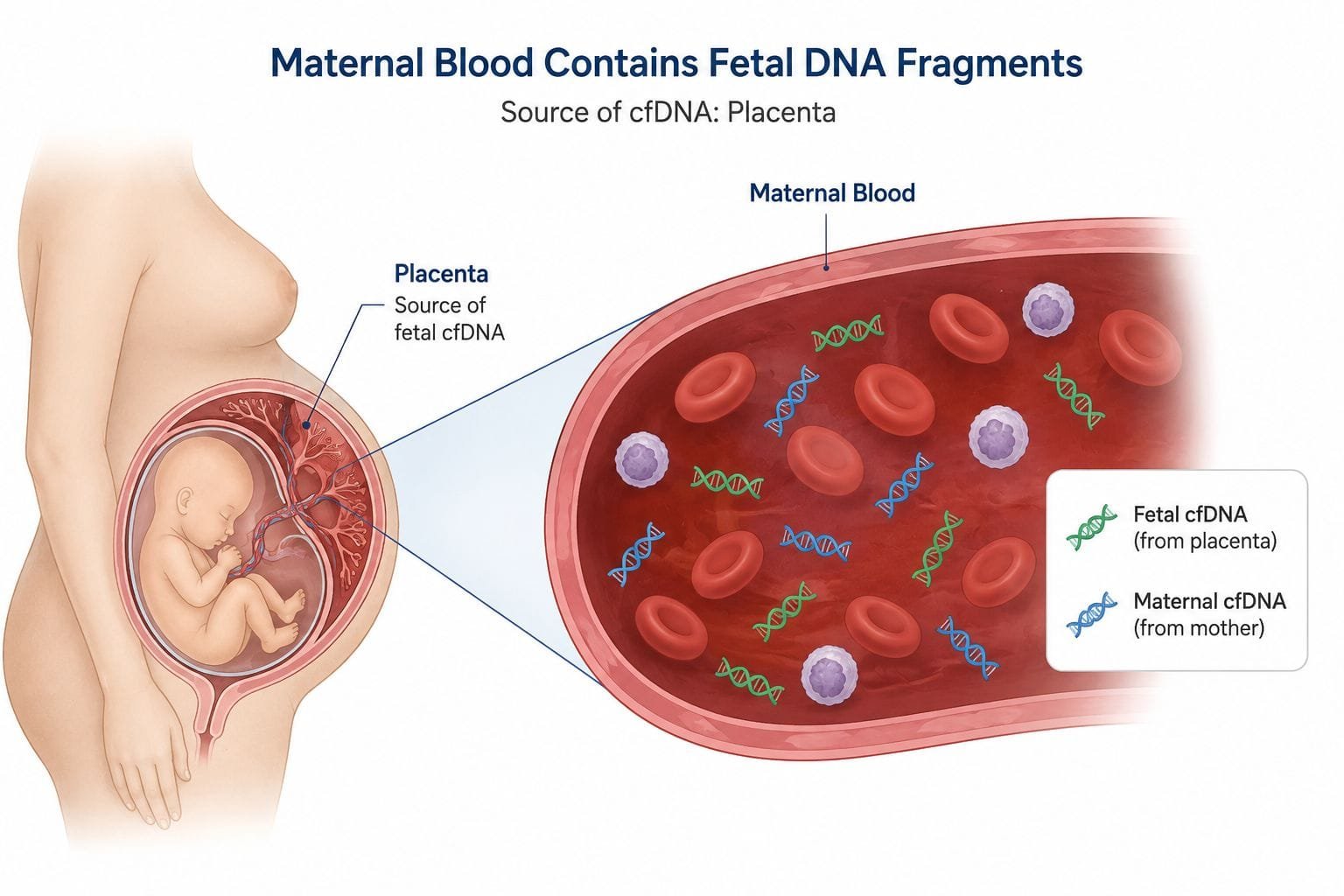
Now that you understand how NIPT works, the natural next question is what it actually screens for.
With the science clear, the reader’s next question is practical: what does this test actually look for?
Every NIPT panel in Dubai starts with the same three conditions. Trisomy 21, or Down syndrome, is the most common and results from an extra copy of chromosome 21. Trisomy 18 (Edwards syndrome) and trisomy 13 (Patau syndrome) are rarer and usually more severe, often involving significant developmental and physical challenges. A basic panel screens for all three.
Beyond the core three, many providers offer add-ons. Fetal sex chromosome analysis and gender detection are common add-ons. Some panels also flag sex chromosome conditions like Turner syndrome or Klinefelter syndrome. Microdeletion syndromes, where a small piece of a chromosome is missing, appear on extended panels. These add-ons are optional and not always included in the base price.
A client asked me last month whether her AED 950 basic panel would tell her the baby’s sex. It would, because that provider’s basic tier includes fetal sex chromosome analysis and gender detection alongside the three trisomies. But when she asked about a microdeletion screen, I had to point her to the advanced tier at AED 1,250, which adds that further coverage. That gap between basic and advanced is where surprise costs hide.
NIPT reads cell-free DNA, so it cannot see the baby’s shape. Neural tube defects, such as spina bifida, and structural problems, such as heart or limb differences, are invisible to this test. The anatomy ultrasound, usually done around 20 weeks, remains essential. No blood test replaces it.
Basic panels cover the three trisomies, plus fetal sex in many cases. Extended panels add microdeletions and additional sex chromosome conditions. The clinical value of microdeletion screening is debated. These conditions are rarer, and positive predictive value can be lower. Before paying, confirm exactly which conditions the provider’s panel includes.
Knowing what NIPT screens for raises the question of who should take it and when. The next section answers both.
You now know what NIPT screens for. The next question is whether it applies to your situation, and the honest answer is that it applies to far more pregnancies than most people assume.
NIPT is a blood test that analyses fetal DNA fragments in maternal blood, offered from about 10 weeks of pregnancy. Before that point, the proportion of cell-free DNA (cfDNA) from the placenta, called the fetal fraction, is often too low to read reliably. Testing too early risks a “no result” outcome, which means a redraw, a delay, and unnecessary anxiety.
After seven years of sitting across from expectant parents in Dubai clinics, the 10-week mark is still the question I answer most often: “Is it too early?” Ten weeks gives the test its best chance of a clear answer the first time.
Several factors make NIPT worth considering:
The ACOG 2026 practice advisory supports offering prenatal genetic screening and diagnostic testing to all pregnant patients regardless of age or risk. NIPT is available to women of any age and risk profile. If you are pregnant in Dubai and want early information about trisomy 21, 18, or 13, NIPT is a reasonable option to discuss with your provider.
Twins, IVF pregnancies, and maternal obesity can all affect how NIPT performs and how results should be interpreted. With twins, the test reads a combined fetal fraction from both placentas, which can complicate interpretation. IVF pregnancies, particularly those involving donor eggs, may have different baseline characteristics.
Higher maternal weight can lower the fetal fraction, increasing the chance of a “no result.” None of these situations rules out NIPT, but your provider needs the full picture to interpret results correctly.
With suitability established, your next question is how accurate this test is and what the numbers really mean.
You now know NIPT applies to you. The next question is the one that actually keeps people up at night: how much can you trust the result? The honest answer is more useful than the reassuring one.
NIPT detects trisomy 21, 18, and 13 with greater than 99% sensitivity. Sensitivity means the proportion of actual cases the test correctly identifies. If 100 pregnancies carry trisomy 21, a test with 99% sensitivity will flag 99 of them.
But that single number hides real variation. Sensitivity is 99% for trisomy 21, 97% for trisomy 18, and 92% for trisomy 13. The rarer the condition, the harder it is to catch every case.
I expected the 99% to be the number that landed. It wasn’t. A patient in her second trimester sat across from me, and the figure that made her lean forward was 92%, the sensitivity for trisomy 13. “So it’s not perfect for everything,” she said. That was the moment the conversation shifted from reassurance to honesty, and it’s the conversation I now have first.
Sensitivity tells you how well the test finds true cases. Positive predictive value (PPV) tells you something different: how likely a positive result is to be a true positive. And PPV depends on how common the condition is in the population tested.
For trisomy 21, PPV is 91% in high-risk pregnancies and 91.8% in the general population. For trisomy 13, the gap is stark: 87% in high-risk versus 37.2% in the general population. A high-risk result is not a diagnosis; it means confirmatory testing is needed.
False positives happen. A test can flag a chromosome difference that isn’t there. This is more common for rarer conditions like trisomy 13 in the general population, where PPV drops to 37.2%. False negatives also occur, though less often for trisomy 21.
This is why confirmatory testing is essential after a high-risk result. No screening test, however good, replaces a diagnostic test.
Sometimes the lab cannot read the sample. Low fetal fraction, the proportion of cell-free DNA from the placenta, can cause a “no result” outcome. This is a technical limitation, not a sign of a problem.
NIPT screens only for specific chromosome differences. It cannot detect:
With accuracy covered, the next distinction matters most: screening is not diagnosis. That is where the follow-up pathway begins.
The previous section covered NIPT’s accuracy and its limits. The natural next question is what a high-risk result actually means, and what comes next.
NIPT is a screening test, not a diagnostic test. Screening estimates risk. It cannot confirm a chromosomal condition. This is the single most important concept to hold onto.
A diagnostic test gives a definitive answer. Amniocentesis and CVS are the two diagnostic tests available in pregnancy.
Amniocentesis samples amniotic fluid, typically from about 15 weeks. CVS samples placental tissue, typically between 11 and 13 weeks. Both carry a small miscarriage risk.
In a July consultation, a couple sat across from me weighing amniocentesis after a high-risk NIPT result. The fear in the room was the word “miscarriage.” I pulled up the RCOG guideline and read the figure aloud: below 0.5% for a skilled operator. The CDC puts amniocentesis at 0.25% to 0.50% at 15 to 18 weeks. That specific number, not the vague “small risk” they had read online, is what let them breathe. The marketing never mentions that the risk is quantifiable and low. That is the differentiator I now lead with.
A high-risk NIPT result is not a diagnosis. It means the test flagged an increased likelihood. Most women who receive a high-risk result go on to have a healthy baby.
The result is a signal to pursue diagnostic testing, not a verdict.
Genetic counselling is available in Dubai, and it is the step most people skip when they try to process a high-risk result alone.
| Feature | NIPT | Amniocentesis | CVS |
|---|---|---|---|
| Type of test | Screening | Diagnostic | Diagnostic |
| Sample | Maternal blood | Amniotic fluid | Placental tissue |
| Timing | From about 10 weeks | From about 15 weeks | From about 11–13 weeks |
| Miscarriage risk | No miscarriage risk | Small miscarriage risk | Small miscarriage risk |
| Result | Risk estimate | Definitive diagnosis | Definitive diagnosis |
With the clinical pathway clear, the practical concern shifts to cost and where to get tested in Dubai.
You now understand the clinical pathway: NIPT is a screening test, not a diagnosis, and a high-risk result leads to amniocentesis or CVS for confirmation. The remaining barrier for most expectant parents in Dubai is practical. What does this actually cost, and where do you go?
The honest answer is that prices vary more than most clinics advertise, and the UAE market is shifting quickly.
The UAE NIPT market was valued at USD 23.8 million in 2025 and is projected to reach USD 73.05 million by 2034, growing at a 13.2% compound annual rate.
That growth means new providers enter, existing ones adjust pricing, and the number you see on a website today may not be the number you pay next month. Treat every figure below as a starting point, not a guarantee.
The confirmed price range across Dubai providers sits between AED 899 and AED 1,299. Accuracy Plus Medical Laboratory offers NIPT from AED 899 with reports delivered within 10 to 14 days and home sample collection available.
Amax Healthcare starts at AED 950 for its NIPT Basic panel, which covers trisomies 21, 18, and 13 plus fetal sex chromosome analysis and gender detection, with home collection across Dubai, Sharjah, Ajman, and Abu Dhabi. Dr Plus charges from AED 1,299 with home blood collection by DHA-licensed nurses across Dubai. Sidra Healthcare’s NIPT Basic is priced at AED 1,299 with at-home collection.
Health247 Group advertises NIPT from AED 799, the lowest figure circulating in Dubai. We could not independently confirm that price at the time of writing, so treat it as an advertised starting point to verify directly with the provider before booking.
Sitting in a clinic waiting room last spring, a patient showed me two quotes for the same NIPT panel, AED 950 and AED 1,299, and asked why the gap existed. The answer was turnaround time and laboratory accreditation, not the test itself.
Dubai offers two distinct service models. At-home collection, offered by Amax, Accuracy Plus, Dr Plus, and Sidra, sends a nurse or phlebotomist to your home to draw the blood sample.
This suits busy schedules, late pregnancies where travel is uncomfortable, and families with young children at home.
The trade-off is that you may have less direct access to a genetic counsellor on the day of collection, and you rely on the provider’s logistics to get your sample to the laboratory promptly.
Hospital-based testing, represented by Mediclinic, draws the sample at a clinic or hospital and runs the analysis through its Mediclinic Precise laboratory using next-generation sequencing. Testing is available from 10 weeks, and the panel can determine fetal sex. The advantage is integrated care: the same institution handles collection, analysis, and follow-up consultation. The trade-off is that you must travel to the facility, which matters if you live in Sharjah, Ajman, or further out.
Neither model is inherently better. The right choice depends on your location, your schedule, and how much you value in-person counselling versus convenience.
| Provider | Price (AED) | Collection Method | Panel Coverage | Turnaround Time | Notes |
|---|---|---|---|---|---|
| Sidra Healthcare NIPT Basic | 1,299 | At-home | Trisomies 21, 18, 13 | Not confirmed – verify | At-home collection model; confirm panel details and turnaround directly |
| Health247 Group NIPT Test | 799 (advertised, not confirmed) | Not confirmed – verify | Not confirmed – verify | Not confirmed – verify | Lowest advertised price in Dubai; verify current price and panel before booking |
| Amax Healthcare NIPT Test | From 950 | At-home | Trisomies 21, 18, 13 plus fetal sex chromosome analysis and gender detection (Basic); Advanced at 1,250 adds further coverage | Not confirmed – verify | Home collection across Dubai, Sharjah, Ajman, Abu Dhabi; two-tier panel structure |
| Mediclinic Precise NIPT | Not confirmed – verify | Hospital-based | Not confirmed – verify | Not confirmed – verify | Next-generation sequencing via Mediclinic Precise laboratory; testing from 10 weeks; can determine fetal sex |
Price is the easiest thing to compare and the least informative on its own. An AED 899 test that takes 14 days to report and offers no counselling may cost you more in anxiety than an AED 1,299 test with a quicker turnaround and a genetic counsellor on call.
Turnaround time matters because the wait between blood draw and result is often the hardest part of the process. Accuracy Plus states 10 to 14 days. Other providers do not publish confirmed turnaround figures, so ask before you book.
Accreditation is the quiet quality signal. A laboratory accredited by an internationally recognized body, such as CAP or ISO 15189, follows standardized protocols that reduce the chance of a failed test or an ambiguous result. Mediclinic’s use of its own Mediclinic Precise laboratory with next-generation sequencing is a concrete example of a provider naming its technology. When a provider cannot tell you which laboratory runs your sample, that is a reason to pause.
Counselling is the most overlooked factor. A good provider explains what the test can and cannot tell you before you pay, and walks you through the result afterward. Some at-home models include a phone consultation; some hospital models include an in-person session. Ask explicitly whether genetic counselling is included in the quoted price or billed separately.
Many UAE health insurance plans treat NIPT as an out-of-pocket expense. It is often classified as an elective or advanced screening test rather than a standard prenatal service, which means the insurer may decline coverage or apply it to your deductible. Some plans cover NIPT only when a prior screening result, such as an abnormal nuchal translucency measurement, indicates raised risk.
Do not rely on a phone call. Request a written quote from the provider that itemizes the test fee, the collection fee if any, and the laboratory fee, then submit that to your insurer for written confirmation of coverage. If the insurer declines, you at least know the true out-of-pocket cost before the blood draw, not after.
With cost and providers now clear, the next question is what happens when the result arrives. A low-risk result brings relief. A high-risk result opens a new set of decisions, and the emotional weight of that moment deserves its own careful walkthrough.
The wait is over. You have chosen a provider, given your blood sample, and now the result is in front of you. Whatever it says, the next few days matter more than the number on the page. This guide walks you through both outcomes, step by step, so you know exactly what to do and what to ask.
A low-risk result is genuinely reassuring. It means the test found no evidence of an extra copy of chromosome 21, 18, or 13 in the cell-free DNA (cfDNA) from your placenta. For most women, that is the end of the chromosomal screening conversation.
But it is not the end of prenatal care. A low-risk NIPT result does not replace the detailed anatomy ultrasound, usually done around 18 to 22 weeks. That scan looks at the baby’s physical structure: the brain, heart, spine, limbs, and organs. NIPT cannot see any of that.
The most dangerous moment in prenatal screening is the sigh of relief. A patient I sat with last spring got her low-risk result and immediately asked whether she could skip the anatomy ultrasound. She had read the report as a clean bill of health, not as what it actually is: a screening result that says nothing about structural development. That question, asked within minutes of the result, is the pattern I have learned to watch for. Low-risk does not mean no-risk, and the anatomy scan is not a formality.
Keep your routine prenatal appointments. The low-risk result answers one specific question about three specific chromosomes. It does not replace blood pressure checks, glucose screening, growth scans, or any other part of your antenatal care.
A high-risk result is frightening, and the first thing to know is this: most women with a high-risk NIPT result go on to have a healthy baby. NIPT is a screening test, not a diagnosis. A high-risk result means the test flagged an increased chance, not a certainty.
Here are the exact next steps:
Genetic counselling is not only for high-risk results. The best time to see a genetic counsellor is often before you even take the NIPT, especially if you or your partner have a family history of chromosomal conditions, if you have had a previous pregnancy with a chromosomal abnormality, or if you are over 35.
After any unexpected result, whether high-risk or a no-result due to low fetal fraction, a genetic counsellor can help you understand what happened and what your options are. They are trained to explain complex genetic information in plain language and to support you through the decision-making process without telling you what to do.
Write these down before your appointment and bring them with you. Bring a support person too, someone who can take notes while you listen.
The emotional weight of this process deserves its own dedicated section. Next, we look at the support and counselling resources available in Dubai, because no one should walk through this alone.
The previous section walked through the practical next steps after your results. This one addresses the emotional side that no competitor covers.
How do you sit with uncertainty when it’s about your baby? I draw blood for NIPT roughly 40 times a month, and the question I hear most isn’t about needles. It’s about what happens after. A woman at 10 weeks, the earliest Mediclinic offers testing, once asked if she should wait until she felt calmer. The anxiety doesn’t shrink with time. It just gets a name. The test itself is the easy part; the waiting is what needs support.
Anxiety, fear, and uncertainty are common and valid responses to prenatal screening. They are not signs of weakness. You are not alone in this.
Genetic counselling is available through major hospitals and specialist clinics, including Mediclinic and fetal-maternal medicine centres across Dubai.
A session typically covers explaining your results, discussing options, and supporting your decision-making without directing the choice. It is non-directive by design.
Hospital-based counselling, maternity support groups, and online communities all offer ways to connect. No one should navigate this alone.

With support resources in hand, you’re ready to make a personalised decision. The interactive checklist in the next section helps you do exactly that.
You now have the full picture: the science, the accuracy, the cost, and the support available in Dubai. This checklist helps you apply all of it to your own situation.
This checklist is a starting point for discussion with your doctor. It is not a substitute for medical advice. This checklist takes only a few minutes, and the accuracy gap between NIPT and combined screening is the key fact that decides whether the extra cost is worth it. Answer honestly, then bring the results to your next appointment.
Answer yes or no to each question:
Combined first-trimester screening, which pairs a nuchal translucency ultrasound with serum screening, is the lower-cost alternative. It is less accurate than NIPT.
Bring your answers to your next appointment. The most common remaining questions are answered concisely in the FAQ that follows.
I don’t have a previous message to continue from. This appears to be the first exchange in our conversation, so there’s no partial output to resume. Let me complete the task now by editing the section you provided.
Yes. NIPT is a blood test that analyzes cell-free DNA (cfDNA), small fragments of the baby’s DNA that cross the placenta into your bloodstream. No needle enters the womb, so there is no risk to the baby.
From about 10 weeks of pregnancy. Before this, the fetal fraction (the proportion of cfDNA in your blood sample that comes from the placenta) may be too low, which can cause a “no result” outcome.
It can be performed, but accuracy and interpretation may differ. Fetal sex is less reliable with twins.
Many plans treat it as out-of-pocket. Check with your insurer and request a written quote before booking.
NIPT is a screening test. It tells you whether your baby has a higher chance of a condition, but it cannot confirm it. Amniocentesis is diagnostic: it samples amniotic fluid directly and can confirm a condition. Amniocentesis carries a small miscarriage risk (below 0.5% with a skilled operator); NIPT carries none. The earlier section on accuracy explains what NIPT can and cannot tell you in more detail.
A high-risk result means your baby has a higher chance of a condition, but it does not confirm it. The next step is diagnostic testing, either amniocentesis (from about 15 weeks) or CVS (from about 11 to 13 weeks), to confirm. The earlier section on understanding your results walks through this step by step.